

A focused reagent for NGS library quantification and low-input DNA measurement, engineered for high recovery and reproducibility.
| Number | Specifications | Catalog Price | Add To Cart |
|---|---|---|---|
| YNQ24091 | 500rxns | Online Consult | + |
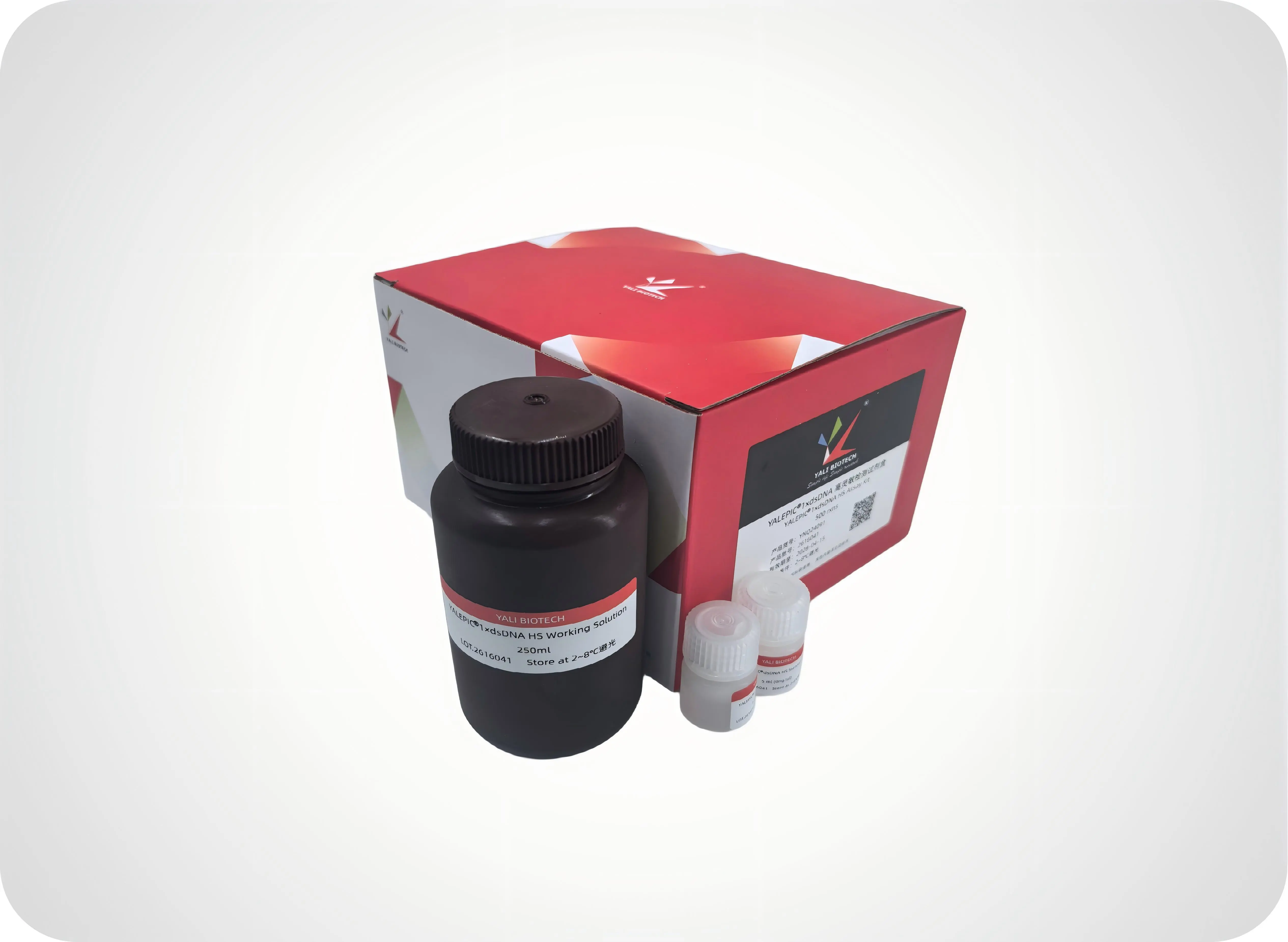
YALEPIC® 1×dsDNA HS Assay Kit is a simple, sensitive and accurate double-stranded DNA (dsDNA) fluorescence quantitative detection kit, which contains pre-mixed working solution (with fluorescent dye) and dsDNA standards. It has good linearity in the range of 0.2 ~ 100 ng dsDNA, allowing accurate quantification of dsDNA concentrations from 10 pg/μl to 100 ng/μl. In addition, it has good impurity tolerance to common contaminants, such as RNA, salts, free nucleotides, proteins, solvents, detergents, etc. This kit provides a ready-to-use working solution so that operators can directly add samples into it, enabling simple dsDNA sample quantification by the Qubit Fluorometer.
dsDNA concentrations from 10 pg/μl to 100 ng/μl.
Store at 2 ~ 8°C protect from light. Adjust the shipping method according to the estination.Do not freeze.
We suggest dsDNA HS Standard store at -20℃ for long-term storage.
This kit uses a fluorescent dye method that specifically binds dsDNA, offering three major advantages over UV spectrophotometry: (1) High selectivity – detects only dsDNA, unaffected by RNA, free nucleotides, proteins, and other impurities; (2) High sensitivity – can detect dsDNA samples as low as 100 pg/microL, superior to the detection limit of UV methods; (3) Wide dynamic range – maintains good linearity in the range of 100 pg/microL to 100 ng/microL, enabling accurate quantification without multiple dilutions.
Yes. This kit is perfectly compatible with the full range of Qubit fluorometers, including Qubit 1.0, Qubit 2.0, Qubit 3.0, and Qubit 4.0. It is also compatible with fluorescence microplate readers from various brands equipped with fluorescence detection modules. When using Qubit, please select the 1x dsDNA High Sensitivity mode in the detection program for instrument calibration and sample measurement.
This kit provides two standards: Standard S1 (0 ng/microL) and Standard S2 (10 ng/microL). Correct usage steps: (1) Before use, invert gently to mix and briefly centrifuge for a few seconds – do not vortex; (2) Pipette 190 microL of working solution into Qubit assay tubes; (3) Add 10 microL of Standard S1 and Standard S2 to the respective tubes; (4) Vortex briefly for 2-3 seconds, briefly centrifuge, incubate in the dark for 2 minutes, then proceed with instrument calibration. Each time you use the Qubit fluorometer for detection, you must recalibrate using the standards provided with the kit.
This kit has good tolerance for the following common contaminants: (1) Salts – NaCl, KCl, etc.; (2) Proteins – BSA, enzymes, etc.; (3) RNA – total cellular RNA, rRNA, etc.; (4) Free nucleotides – dNTPs, NTPs, etc.; (5) Detergents – Triton X-100, Tween-20, SDS, etc.; (6) Organic solvents – ethanol, DMSO, etc. This feature allows users to directly quantify PCR amplification products and unpurified DNA samples without additional purification steps.
The complete kit should be stored at 2-8 degrees C, protected from light. After opening: (1) Working Solution (pre-mixed working solution) should be stored at 2-8 degrees C protected from light, avoiding repeated freeze-thaw; (2) Standard S1 and Standard S2 should be stored at 2-8 degrees C protected from light; (3) Fluorescent dyes are subject to quenching – all components should be handled in the dark before and after use, and caps should be tightened immediately and returned to the refrigerator; (4) Please complete sample detection within the specified time to avoid result deviation due to fluorescence quenching.
The final volume of each reaction in this kit is 200 microL, with working solution volume of 180-199 microL and sample volume of 1-20 microL. The recommended sample volume is 1-10 microL, which can be flexibly adjusted based on the estimated sample concentration. Please calibrate pipettes before use to ensure accurate sampling. After detection, calculate the original sample concentration using the following formula: (instrument reading concentration) x (working solution volume + sample volume) / sample volume.
The YALEPIC 1x dsDNA HS Assay Kit is highly comparable to the Thermo Fisher Qubit dsDNA HS Kit in core performance indicators: both maintain good linearity (R-squared > 0.99) in the 0.1-100 ng dsDNA range; high selectivity for dsDNA with minimal RNA interference; and comparable tolerance to common contaminants such as salts, proteins, and detergents. This kit offers a 500-assay specification with a more advantageous per-test cost, making it a high cost-effectiveness alternative to the Qubit dsDNA HS Kit.
Fluorescent dyes have natural quenching, and fluorescence intensity will slowly decay as incubation time increases. For stable and reliable results, it is recommended to: (1) After adding standards and samples, uniformly incubate in the dark for 2 minutes, then complete all detection within 30 minutes; (2) Avoid excessive temperature differences between samples and standards; (3) Do not expose to strong light for prolonged periods during detection. Following these conditions strictly, inter-batch and intra-batch detection results show good stability and reproducibility.
This kit is suitable for quantifying double-stranded DNA samples from various sources, including but not limited to: (1) NGS libraries – input DNA library quantification for high-throughput sequencing; (2) PCR/qPCR products – dsDNA quantification of amplification products; (3) Genomic DNA – gDNA extracted from cells, tissues, blood, and other samples; (4) Plasmid DNA – plasmid extraction products and restriction digest products; (5) cDNA – cDNA products from reverse transcription; (6) DNA standards – various types of dsDNA standards. The kit has no selectivity for the source species (human, animal, plant, microorganism, virus, etc.) and is universally applicable.
Standard errors or negative fluorescence values typically have the following causes and solutions: (1) Insufficient standard preparation – not fully mixed before use, please invert and briefly centrifuge; (2) Temperature effects – the assay is temperature-sensitive, ensure standards and samples are equilibrated to room temperature before detection; (3) Pipetting errors – use calibrated pipettes; (4) Bubble interference – briefly centrifuge after mixing to remove bubbles; (5) Standard deterioration – check whether standards are within their shelf life and whether they have undergone repeated freeze-thaw or contamination. If the problem persists, check the raw fluorescence values (RFU) of the standards and confirm that the sample fluorescence values fall between those of the standards.



Production center: 4th floor, Building 9, Yangshan Science and Technology
Industrial Park,No. 8 Jinyan Road, Suzhou High-tech Zone
Marketing center: Pujiang High-tech Park, Minhang District, Shanghai
Copyright: 2026 YALI Biotech Co., Ltd.
 Scan to follow us