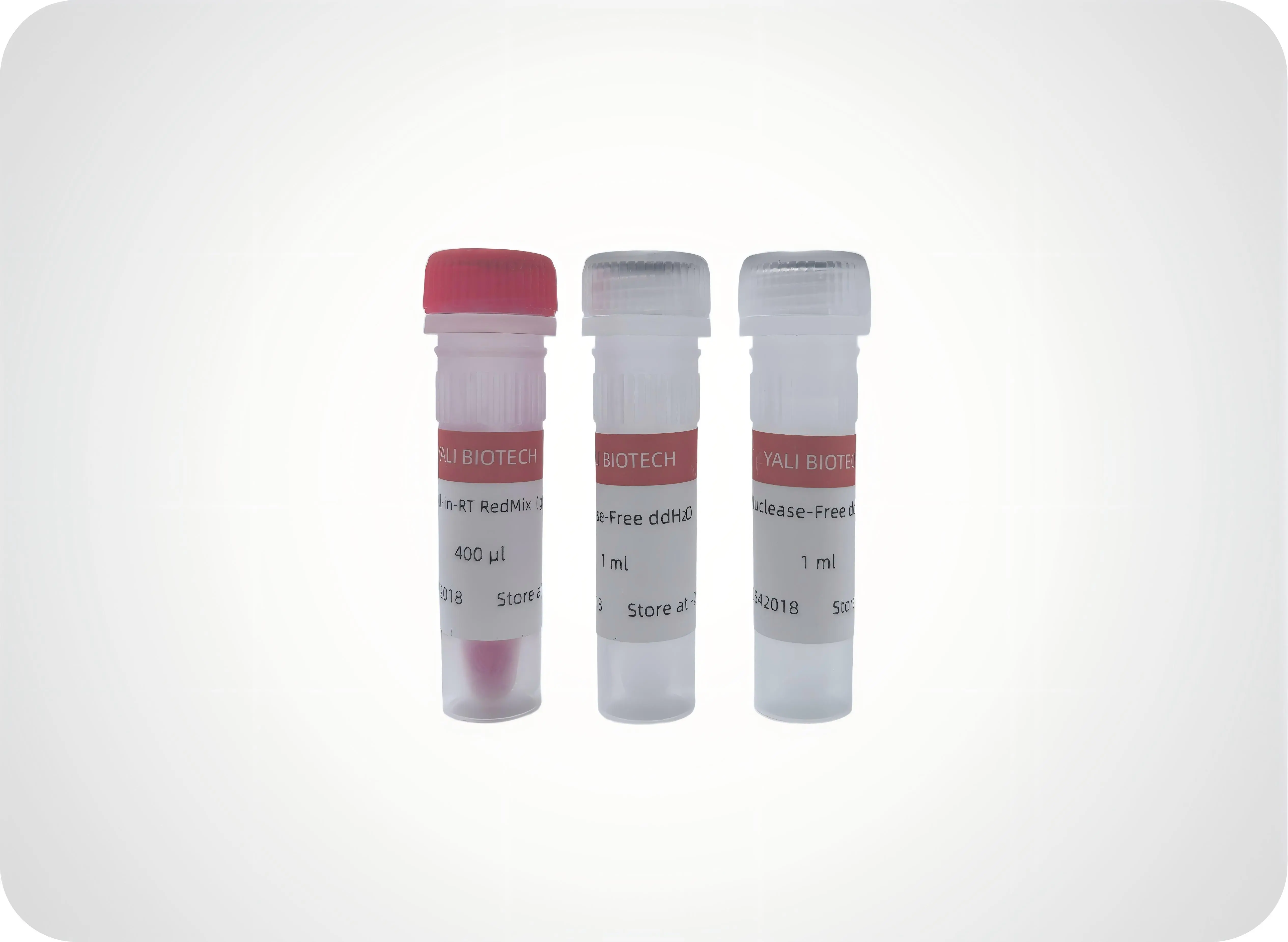

A validated master mix that simplifies routine PCR, cloning, and genotyping with consistent, reproducible results.
| Number | Specifications | Catalog Price | Add To Cart |
|---|---|---|---|
| YEM61001-035 | 3×5ml | Online Consult | + |
| YEM61001-105 | 10×5ml | Online Consult | + |
| YEM61001-205 | 20×5ml | Online Consult | + |
YALEPIC® Taq ZG PCR MasterMix (Dye)contains Taq DNA Polymerase, elongation promoting factor, dNTP and an optimized buffer system. The amplification speed of this product can reach 15 sec/kb, which is suitable for rapid PCR. The maximum amplification speed within 1 kb can reach 1 sec/kb, greatly saving reaction time. The kit has excellent amplification performance and high storage stability. It is suitable for PCR amplification within 7 kb using genome as template and PCR amplification within 10 kb using plasmid and λDNA as template. This product contains loading buffer and tracking dye, so PCR products can be directly loaded for electrophoresis after the reaction, which is convenient to use. The PCR product has an adenine at the 3′ end that can be cloned into the T vector.
Store at -20°C and transport at ≤0°C.
It can be stored at 4°C for 1 months after thawing.
The product contains a low-concentration inert electrophoresis tracking dye. The formulation has been optimized to not interfere with Taq enzyme activity, primer annealing, or DNA amplification. It does not inhibit the PCR reaction at any point and does not affect band clarity.
It can be used directly for colony PCR. The modified Taq enzyme tolerates bacterial impurities. Pick a single colony and add it directly to the reaction system for amplification. In standard scenarios, no pre-lysis of bacteria is needed.
Yes. The amplification products of this master mix naturally have 3′ A-overhangs. After purification, the products can be directly used for T/A cloning ligation without terminal A-addition enzyme treatment.
Aliquoting into single-use portions is recommended, stored at -20 degrees C. After up to 20 freeze-thaw cycles, enzyme activity shows no significant decline. Long-term storage at 4 degrees C is not recommended; short-term (within 3 days) temporary storage is acceptable.
The optimized buffer system enhances impurity tolerance. Crude tissue extracts and simply extracted nucleic acids can be stably amplified. If impurity levels are excessive, appropriately dilute the template concentration.
All specifications in the YEM61001 series have identical formulations, with only different aliquot volumes. Products from the same batch can be freely mixed for reaction system preparation.
25 microL system: 12.5 microL MasterMix + 0.2-0.5 microL each of forward and reverse primers + appropriate template + RNase-free water to 25 microL.
(1) Primer degradation or poor design specificity; (2) Template degradation or concentration too low; (3) Annealing temperature mismatch – set up a temperature gradient to optimize conditions; (4) Reagent degradation from improper storage – test with a new batch of master mix.
Minor color variation between batches is normal and does not affect amplification or electrophoresis results. All products pass COA quality inspection before release.
Appropriately increase template input, fine-tune annealing temperature. If cDNA purity is low, dilute the template to reduce interference from reverse transcription residual inhibitors.
Brief room temperature exposure (<12 hours) generally does not cause loss of effectiveness. After aliquoting, store at -20 degrees C protected from light. A small-scale PCR test can be performed to verify amplification performance before large-scale use.
Compatible with both standard and fast PCR protocols. Short fragments can use shortened extension times, combined with fast temperature control programs to increase experimental speed.




Production center: 4th floor, Building 9, Yangshan Science and Technology
Industrial Park,No. 8 Jinyan Road, Suzhou High-tech Zone
Marketing center: Pujiang High-tech Park, Minhang District, Shanghai
Copyright: 2026 YALI Biotech Co., Ltd.
 Scan to follow us