
A validated master mix that simplifies rare-target detection, pathogen diagnostics, and copy-number analysis with consistent, reproducible results.
| Number | Specifications | Catalog Price | Add To Cart |
|---|---|---|---|
| YQ32032 | 5ml | Online Consult | + |
YALEPIC® Probe qPCR MasterMix(UDG)VK is a master mix for probe qPCR to detect DNA templates (such as DNA viruses). Equipped with the most suitable buffer optimized for the qPCR system, amplification performance with multiple targets, amplification specificity and sensitivity for detection of low-copy genes and amplification curve shape are significantly improved. It can provide excellent amplification curve within a wide quantitative range, and accurately quantify and detect target genes, with good repeatability and high reliability. It has wide compatibility in terms of template type, template GC content, and primer Tm values. And it also has good tolerance to impurities and is suitable for use in a variety of testing scenarios. It is convenient to use and compatible with fast program to reduce test time. In addition, the dUTP/UDG anti-contamination system is introduced in it, which can work at room temperature to eliminate the influence of amplification product contamination on qPCR and ensure the accuracy of results.The product is a 2 × master mix. Only primers, probes and templates need to be added additionally.
High Precision: Designed for low-abundance targets, it captures low-template, low-concentration, and low-input signals with superior stability, outperforming similar products.
dUTP/Heat-labile UDG system: it effectively eliminates contaminants at room temperature, ensuring cleaner and more reliable experiments.
Pre-Mixed Technology: Features a fully pre-mixed formula, offering unparalleled flexibility and stability.
Store at -20°C and protect from light. Transport at ≤0°C.
Probe-based qPCR (such as TaqMan method) generates fluorescence signals through target-specific probe complementary binding to the target sequence, offering higher specificity and multiplex detection capability. It is suitable for SNP genotyping, allele identification, and other applications requiring high resolution, but has higher costs and more stringent primer/probe design requirements. Dye-based method (SYBR Green) detects signals through fluorescent dye binding to double-stranded DNA, offering low cost and strong versatility, but with relatively lower specificity and inability to distinguish non-specific amplification products. This product is a probe-based dedicated master mix, suitable for experimental scenarios requiring high specificity.
This product has a built-in dUTP/UDG contamination prevention system, with dUTP and uracil-DNA glycosylase (UDG) already included in the master mix. Before the qPCR reaction begins at room temperature, UDG selectively cleaves PCR contaminants (aerosols) containing dUTP, rendering them unable to serve as amplification templates. After PCR thermal cycling begins (typically >50 degrees C), the heat-labile UDG is irreversibly inactivated and does not affect subsequent amplification efficiency. Users do not need to add any additional anti-contamination components – ready to use.
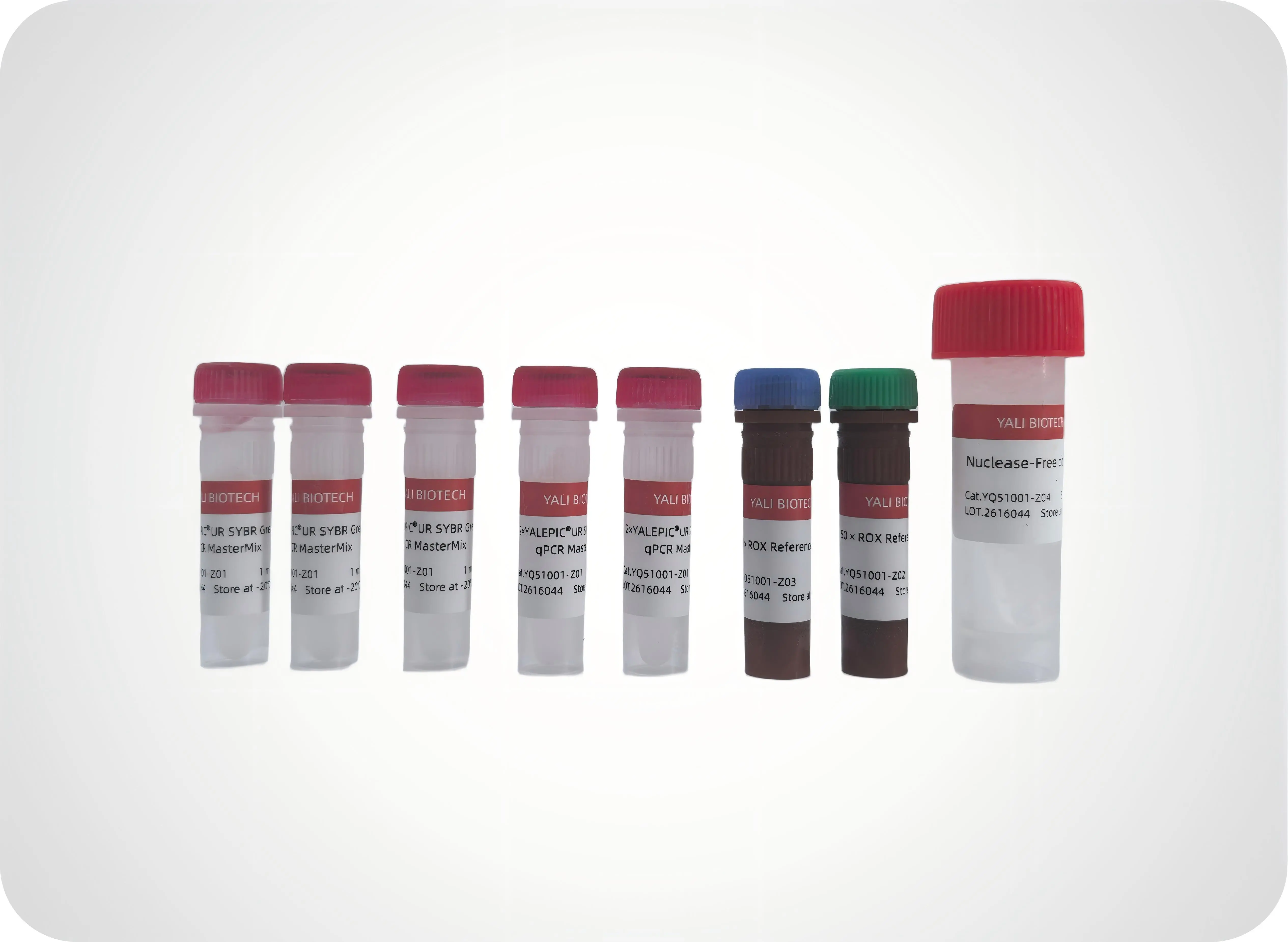
This product is available in two versions: 50x ROX Reference Dye 1 and 50x ROX Reference Dye 2. Selection guidelines: ABI 7900HT/7300 Real-Time PCR System and StepOnePlus instruments use ROX Reference Dye 1; ABI 7500/7500 Fast/Stratagene Mx3000P instruments use ROX Reference Dye 2; Roche LightCycler series and Bio-Rad CFX series instruments that do not require ROX do not need it added. Different instrument models have different requirements for ROX reference fluorescence – please confirm your instrument model and select accordingly.
Yes. This product is based on an optimized buffer system and hot-start DNA polymerase, suitable for multiplex fluorescent probe qPCR detection, supporting at least four-plex simultaneous target detection. The product demonstrates good signal separation and consistent amplification performance across different fluorescence channels (FAM/VIC/CY5, etc.).
Yes. This product has undergone specific buffer optimization for low-copy templates. Combined with a new-generation hot-start DNA polymerase, it can detect fewer than 10 copies of nucleic acid template in a 20 microL system. It demonstrates excellent amplification efficiency and linearity in low-abundance target detection, suitable for rare transcript detection, trace pathogen detection, and other applications.
This product is recommended for long-term storage at -20 degrees C, and should be maintained below 0 degrees C during transport and short-term storage. Freeze-thaw stability testing has verified that the product maintains stable amplification performance after 50 repeated freeze-thaw cycles (Ct value deviation within +/-0.5). However, to avoid unnecessary performance fluctuations, aliquoting after first use is recommended to reduce repeated freeze-thaw cycles.
Abnormal amplification curves can typically be investigated from the following aspects: (1) Check template concentration – both too high and too low may cause abnormal curves; try gradient dilution and re-detection; (2) Confirm primer and probe design quality and concentration ratio; (3) Check for bubbles in the reaction system – centrifuge before loading to remove; (4) Confirm fluorescence acquisition step is correctly set – TaqMan probe method typically acquires signal at the end of annealing or extension, and must not be mixed with dye-based methods; (5) Rule out consumable and instrument cross-well interference. If problems persist, use positive controls to verify reagent performance.
Yes. This product is compatible with fast qPCR amplification protocols, enabling amplification detection within shortened cycle times to improve laboratory detection throughput. Under fast protocols, the product maintains good amplification efficiency (tested at >99%) and detection consistency.
Non-specific amplification and NTC signal are typically caused by: (1) Suboptimal primer design with dimers or hairpin structures; (2) Annealing temperature too low – try increasing annealing temperature (typically 2-5 degrees C increment); (3) Magnesium ion concentration too high – reduce appropriately or select a more compatible master mix system; (4) Aerosol contamination in the environment – the built-in dUTP/UDG contamination prevention system provides effective inhibition, but strengthening laboratory best practices is still recommended.




Production center: 4th floor, Building 9, Yangshan Science and Technology
Industrial Park,No. 8 Jinyan Road, Suzhou High-tech Zone
Marketing center: Pujiang High-tech Park, Minhang District, Shanghai
Copyright: 2026 YALI Biotech Co., Ltd.
 Scan to follow us