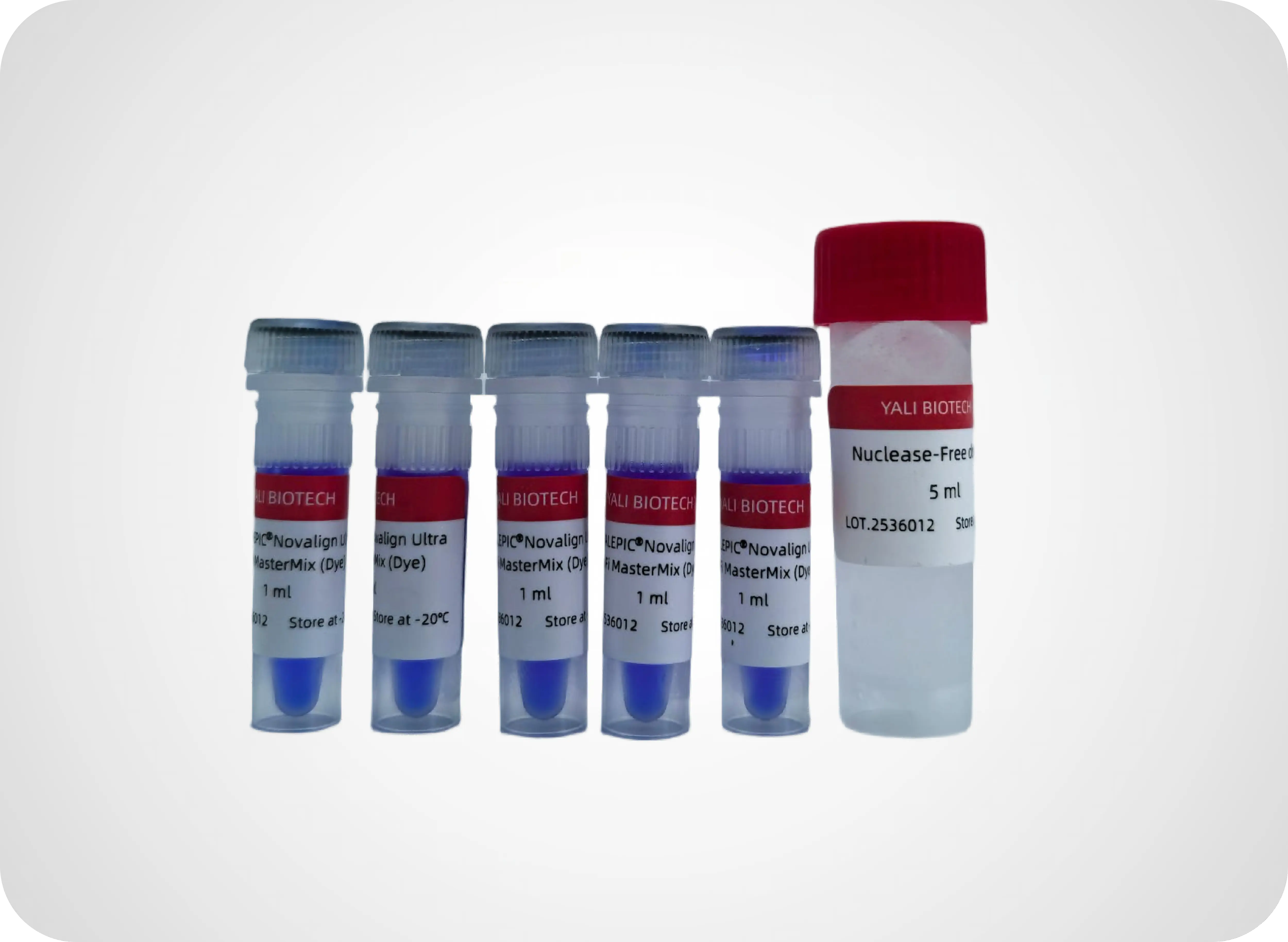
A validated master mix that simplifies cloning, site-directed mutagenesis, and template for sequencing with consistent, reproducible results.
| Number | Specifications | Catalog Price | Add To Cart |
|---|---|---|---|
| YEM51006 | 5ml | Online Consult | + |
YALEPIC®Novalign Flash HiFi MasterMix utilizes the new generation of Novalign Flash Fidelity DNA Polymerase with the characteristics of high fidelity (mismatch rate is 1/108 of conventional Taq DNA polymerase) and rapid amplification speed (≤3 kb: 1 sec/kb; ≤10 kb: 5 sec/kb). This product contains Novalign Flash Super-Fidelity DNA Polymerase, dNTP and optimized buffer. It only requires the addition of primers and templates for amplification, efficiently amplifies genomic fragments (≤15 kb) and plasmid DNA (≤20 kb).
Store at -20°C and transport at ≤0°C.
The fidelity of YALEPIC Novalign Flash HiFi MasterMix is approximately 108 times that of regular Taq DNA polymerase. Its DNA polymerase has 3′ to 5′ exonuclease (proofreading) activity, which can real-time identify and excise mismatched nucleotides during amplification, ensuring extremely high replication accuracy. This characteristic makes it particularly suitable for gene cloning, site-directed mutagenesis analysis, NGS library construction, and other applications with stringent sequence fidelity requirements.
The extension speed of this product has two tiers based on target fragment length: for fragments <=3 kb: extension speed up to 1 sec/kb; for fragments <=10 kb: extension speed 5 sec/kb. Compared to conventional high-fidelity polymerases at 15-30 sec/kb, this product can significantly shorten PCR reaction time, enabling fast PCR. For difficult long fragment amplification, appropriately extending extension time based on actual conditions is recommended to ensure yield.
This product is available in two versions: YEM51006-A (non-Dye, standard) – does not contain tracking dye, suitable for applications requiring fluorescence signal detection (such as qPCR, NGS library amplification); YEM51006-B (Dye version) – contains electrophoresis tracking dye, allowing direct agarose gel electrophoresis after PCR, simplifying operation and saving time.
Yes. This product’s formulation has been optimized with strong complex template compatibility, capable of directly amplifying high GC content fragments within a certain range. For extremely high GC content difficult templates, the following optimization strategies are recommended: (1) Appropriately increase denaturation temperature or extend denaturation time; (2) Use gradient annealing temperature to test optimal conditions. For further optimization, contact YALI Biotech technical support for professional guidance.
YALEPIC Novalign Flash HiFi MasterMix produces blunt-ended amplification products, because its DNA polymerase has 3′ to 5′ proofreading activity and does not add extra A bases at the 3′ end of products. Direct use of blunt-end cloning vectors for ligation is recommended for highest efficiency. If TA cloning is necessary, first purify the PCR product to completely remove the high-fidelity polymerase, then use Taq DNA polymerase to add A-tails to the 3′ end of the purified blunt-end products, followed by TA ligation.
Possible causes and solutions: Low annealing temperature – increase annealing temperature; gradient annealing temperature optimization recommended (typically test 50-65 degrees C range). Poor primer design – redesign primers, ensure 3′ end specificity, avoid self-complementary primers. Primer concentration too high – reduce primer concentration (0.2-0.5 microM final concentration recommended). Inappropriate template amount – reduce template usage; 50-200 ng genomic DNA is typically appropriate. Too many cycles – reduce cycle number; 25-35 cycles typically sufficient for most amplification needs. If smearing persists, use freshly extracted high-quality template DNA and check the storage condition of all reagents.
No. The MasterMix may show small amounts of precipitate after low-temperature storage or repeated freeze-thaw, which is a normal phenomenon. Before use, remove the MasterMix and thaw at room temperature, gently inverting to mix every 10-15 minutes until the precipitate is fully dissolved, then briefly centrifuge to collect. Performance testing shows that multiple freeze-thaw cycles (up to 30) have no significant effect on PCR amplification performance. For long-term storage, aliquot after first use to reduce repeated freeze-thaw.
Follow these best practices to minimize PCR contamination risk: Spatial separation: designate a dedicated PCR setup area in the lab, strictly separated from template handling and PCR product analysis areas. Dedicated equipment: equip the setup area with dedicated pipettes, disposable filtered tips, and PCR tubes; avoid cross-use. Proper technique: briefly centrifuge PCR reagent tubes before opening to settle liquid to the bottom, reducing contamination of gloves and pipettes. Template management: dilute DNA templates at your own bench, bringing only the required dilutions into the setup area. Product isolation: never bring PCR tubes containing amplification products into the setup area after PCR; perform subsequent electrophoresis detection in designated areas. Set up controls: set up no-template negative controls (NTC) for every PCR reaction to monitor for DNA contamination.




Production center: 4th floor, Building 9, Yangshan Science and Technology
Industrial Park,No. 8 Jinyan Road, Suzhou High-tech Zone
Marketing center: Pujiang High-tech Park, Minhang District, Shanghai
Copyright: 2026 YALI Biotech Co., Ltd.
 Scan to follow us