A validated master mix that simplifies gene-expression analysis and low-copy quantification with consistent, reproducible results.
| Number | Specifications | Catalog Price | Add To Cart |
|---|---|---|---|
| YQ51005 | 5ml | Online Consult | + |
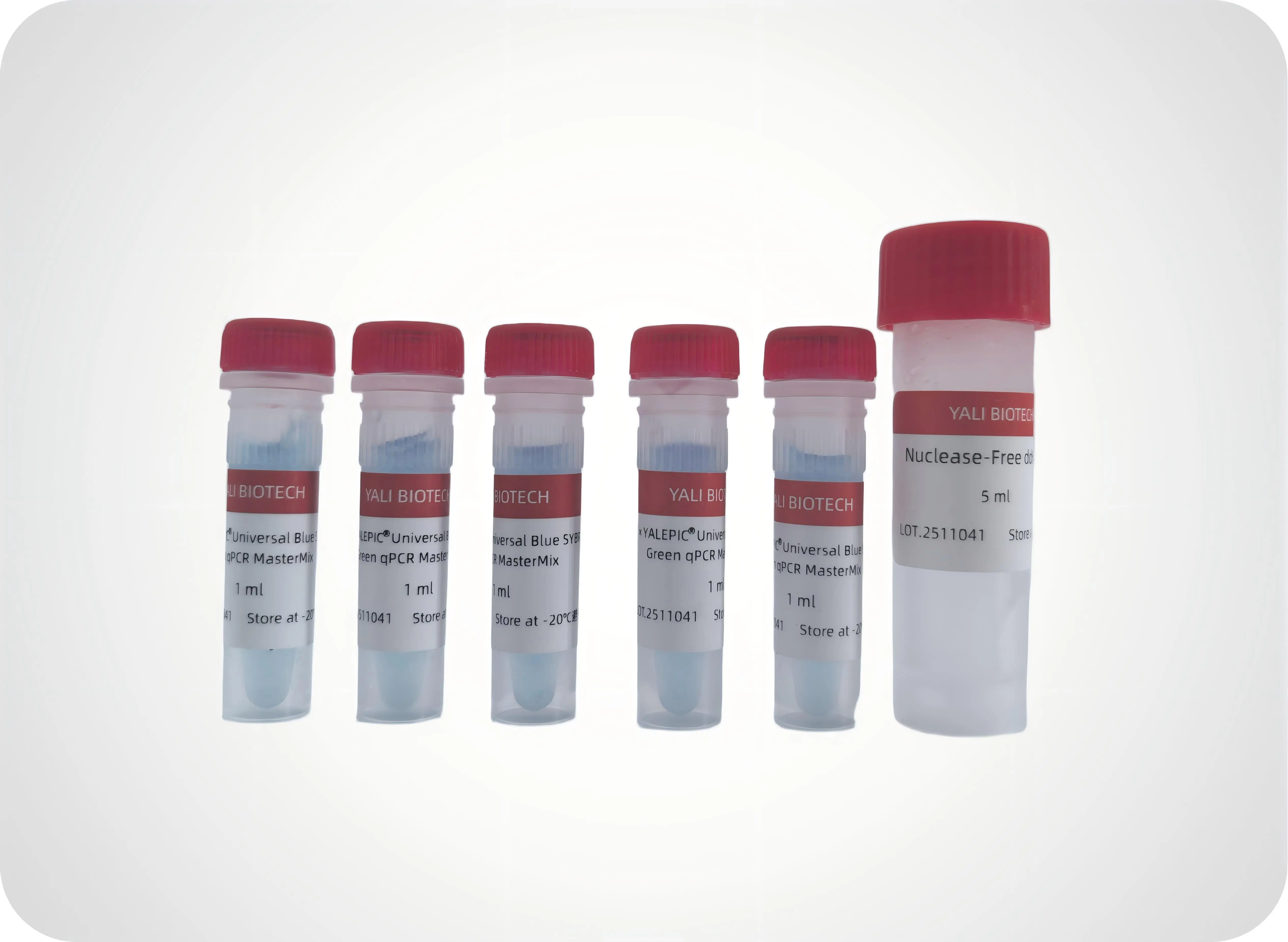
YALEPIC®Universal Blue SYBR Green qPCR MasterMix is a premium qPCR premix designed for exceptional performance with the SYBR Green I intercalating fluorescence method. Its distinct blue color ensures easy and precise sample handling. Paired with an advanced, qPCR-optimized buffer and proprietary specificity enhancers, this premix is perfect for achieving highly reliable and sensitive results.The inclusion of a specially formulated ROX Passive Reference Dye ensures seamless compatibility across various qPCR instruments, with no need for ROX concentration adjustments.
Blue Visual Guidance: It effectively reduces pipetting errors, making it especially suitable for high-throughput workflows and beginner users.
High Sensitivity Detection:An optimized formulation ensures clear amplification curves and accurate quantification results, even at low template concentrations.
Versatility and Stability:Precisely optimized for broad compatibility, it supports DNA, cDNA, and various sample types. Designed for stable performance and long-term storage peace of mind.
Store at -20°C and protect from light. Transport at ≤0°C.
This product has pre-mixed universal ROX Reference Dye, compatible with all mainstream real-time PCR instruments, including ABI (e.g., 7500, 7900HT, StepOne, QuantStudio series), Bio-Rad (CFX96, iQ5), Roche (LightCycler series), Agilent, and other ROX-dependent and non-dependent instruments, without additional ROX or instrument setting adjustments. If you are unsure about instrument compatibility, contact technical support for confirmation.
No. The blue tracking dye is an inert dye that does not participate in the PCR amplification reaction, does not affect DNA polymerase activity, fluorescence signal acquisition, or amplification efficiency. Its sole purpose is to provide a visual cue during pipetting, helping identify sample positions and preventing missed, incorrect, or duplicate additions, particularly suitable for manual preparation of high-throughput reaction plates. Multiple brands have launched similar dye tracking products that have been fully validated.
Possible causes and solutions: Insufficient cycle number: check that the PCR program has sufficient cycles (40 cycles recommended) and confirm that fluorescence signal acquisition is enabled during the extension phase. Primer issues: confirm whether primers are degraded or improperly designed; consider re-synthesizing primers or optimizing primer design. Template issues: check whether template is degraded or concentration is too low; consider re-preparing template or increasing template input. Hot-start activation: confirm sufficient pre-denaturation/hot-start time (this product’s antibody-modified hot-start enzyme requires sufficient initial denaturation time to fully release enzyme activity).
High Ct values are typically related to low template amount, low amplification efficiency, or inhibitors in the system. Recommended solutions: Increase template input: appropriately increase the cDNA template proportion (not exceeding 20% of total volume). Optimize reverse transcription step: increase RNA input or switch to a more efficient reverse transcription kit. Optimize primer design: ensure amplicon length is 80-200 bp, avoiding high GC content or consecutive repeat structures. Eliminate PCR inhibitors: inhibitors carried in the template (such as ethanol, phenol) affect amplification efficiency; try gradient dilution of template or re-purify template. Check reaction conditions: confirm amplification efficiency is within 90%-110% via standard curve; if not, optimize annealing temperature or switch to a three-step protocol.
NTC amplification signals typically occur in two situations: Primer dimers (Ct > 35, Tm < 80 degrees C): non-specific amplification from primer dimers is quite common. Optimize primer design, reduce primer concentration (e.g., from 500 nM to 200-300 nM), or increase annealing temperature. Reagent or water contamination (Ct < 35): indicates the reaction system has been contaminated with exogenous DNA. Replace with fresh reagents and deionized water, prepare the reaction system in a laminar flow hood, and use filtered tips. Aerosol contamination: if large amounts of qPCR or cloning experiments have been previously performed in the lab, amplification product aerosol contamination may be present.
Double peaks in the melt curve typically indicate non-specific amplification or primer dimers. Solutions: Extra peak Tm < 80 degrees C: likely primer dimers. Reduce primer concentration or increase annealing temperature. Extra peak Tm > 80 degrees C: likely non-specific product amplification. Use BLAST to check primer specificity, and redesign primers if issues persist. Also use NRC (No RT Control) to rule out gDNA contamination. Gel verification: if necessary, confirm PCR product size matches expectations via high-resolution agarose gel electrophoresis.
Poor reproducibility is typically related to pipetting errors or instrument status: Pipetting errors: regularly calibrate pipettes, use stable-performance pipettes. Consider enlarging the reaction volume (e.g., from 20 microL to 25-30 microL) or performing high-fold dilution of template and adding in larger volumes to reduce relative pipetting error. Preparing a master mix before dispensing into wells can also effectively reduce error. Instrument issues: regularly calibrate the real-time PCR instrument to ensure consistent temperature control across all wells. Template amount too low: random error increases at very low template concentrations; increase template amount to keep Ct values between 15-30.
This product has been buffer-optimized for high GC content templates, effectively improving amplification efficiency. If amplification difficulties persist, recommendations: Optimize annealing temperature: determine optimal annealing temperature through temperature gradient PCR; may need to decrease annealing temperature by 2-4 degrees C if necessary. Use three-step protocol: adding a temperature gradient between annealing and extension helps denature high GC templates. Add PCR enhancers: consider using DMSO or betaine to help open secondary structures in high GC regions. Design shorter amplicons: control amplicon length within 100-150 bp.
This product should be stored at -20 degrees C protected from light, minimizing repeated freeze-thaw. Aliquoting is recommended to reduce freeze-thaw cycles. Transport conditions: <0 degrees C (ice packs or dry ice). If slight precipitate appears after long-term storage at -20 degrees C, this is normal. After thawing at room temperature, invert to mix and it can be used normally. Do not vortex to avoid bubble formation.
YALI Biotech YALEPIC Universal Blue has significant advantages in multiple dimensions: Better cost-effectiveness: compared to Thermo Fisher Power SYBR Green Master Mix and Bio-Rad iTaq Universal SYBR Green Supermix and other imported brands, this product offers comparable performance at a more competitive price. Tracking design: the unique blue tracking system is superior to most imported products in pipetting accuracy, especially for high-throughput manual pipetting, effectively reducing operational error rates. Full platform compatibility: pre-mixed universal ROX, compared to some products that require users to add ROX or differentiate ROX models, this product is simpler to use. Local technical support: domestic production with faster technical support response, shorter supply cycles, and more convenient after-sales service. Core performance: based on antibody-based hot-start DNA polymerase and specially optimized buffer system, it effectively inhibits non-specific amplification, significantly improving amplification efficiency and detection sensitivity, suitable for low-copy template detection and high GC content template amplification.




Production center: 4th floor, Building 9, Yangshan Science and Technology
Industrial Park,No. 8 Jinyan Road, Suzhou High-tech Zone
Marketing center: Pujiang High-tech Park, Minhang District, Shanghai
Copyright: 2026 YALI Biotech Co., Ltd.
 Scan to follow us