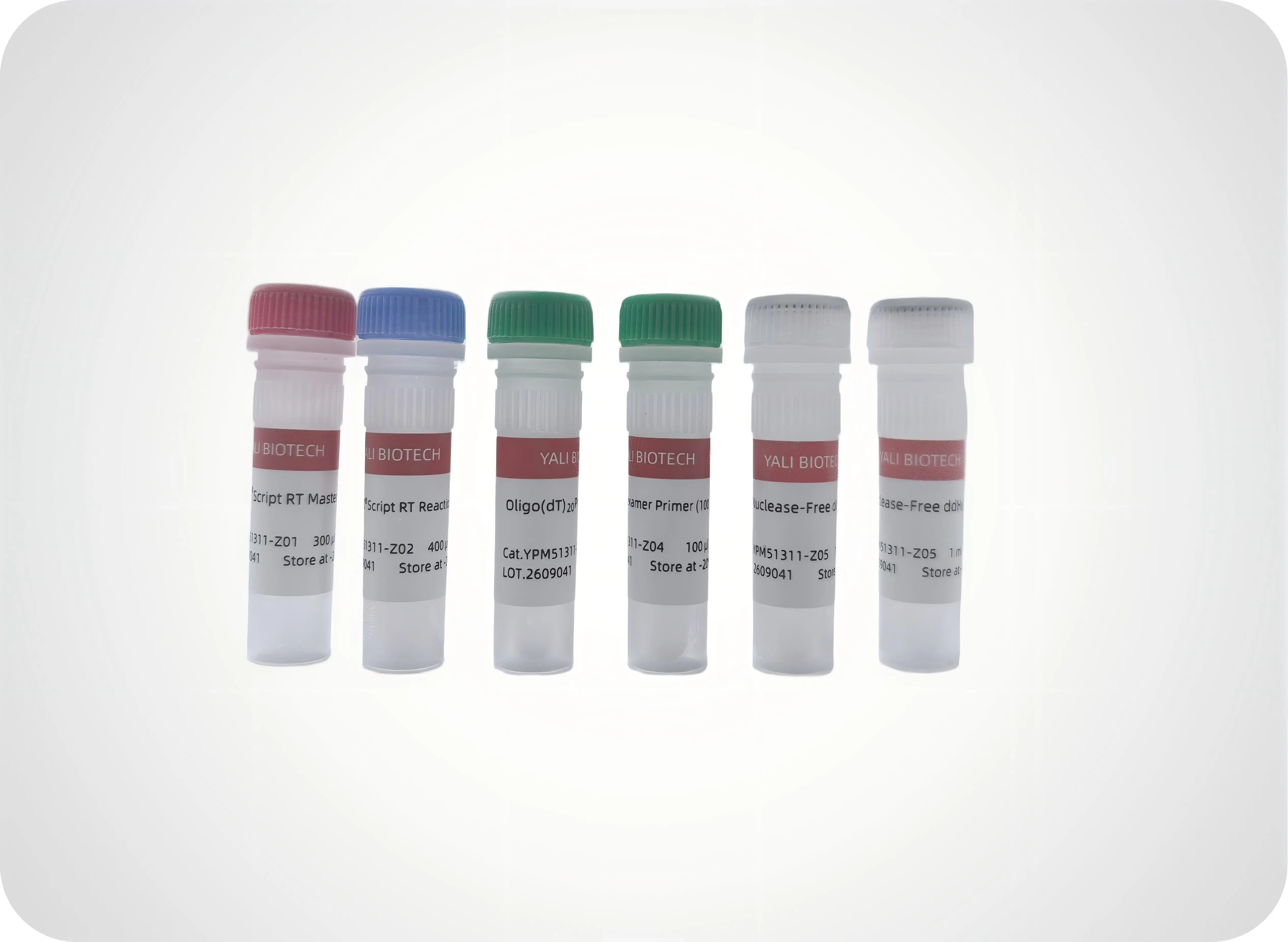
A validated kit that simplifies RT-qPCR and transcriptome analysis with consistent, reproducible results.
| Number | Specifications | Catalog Price | Add To Cart |
|---|---|---|---|
| YPM51311 | 100rxns | Online Consult | + |
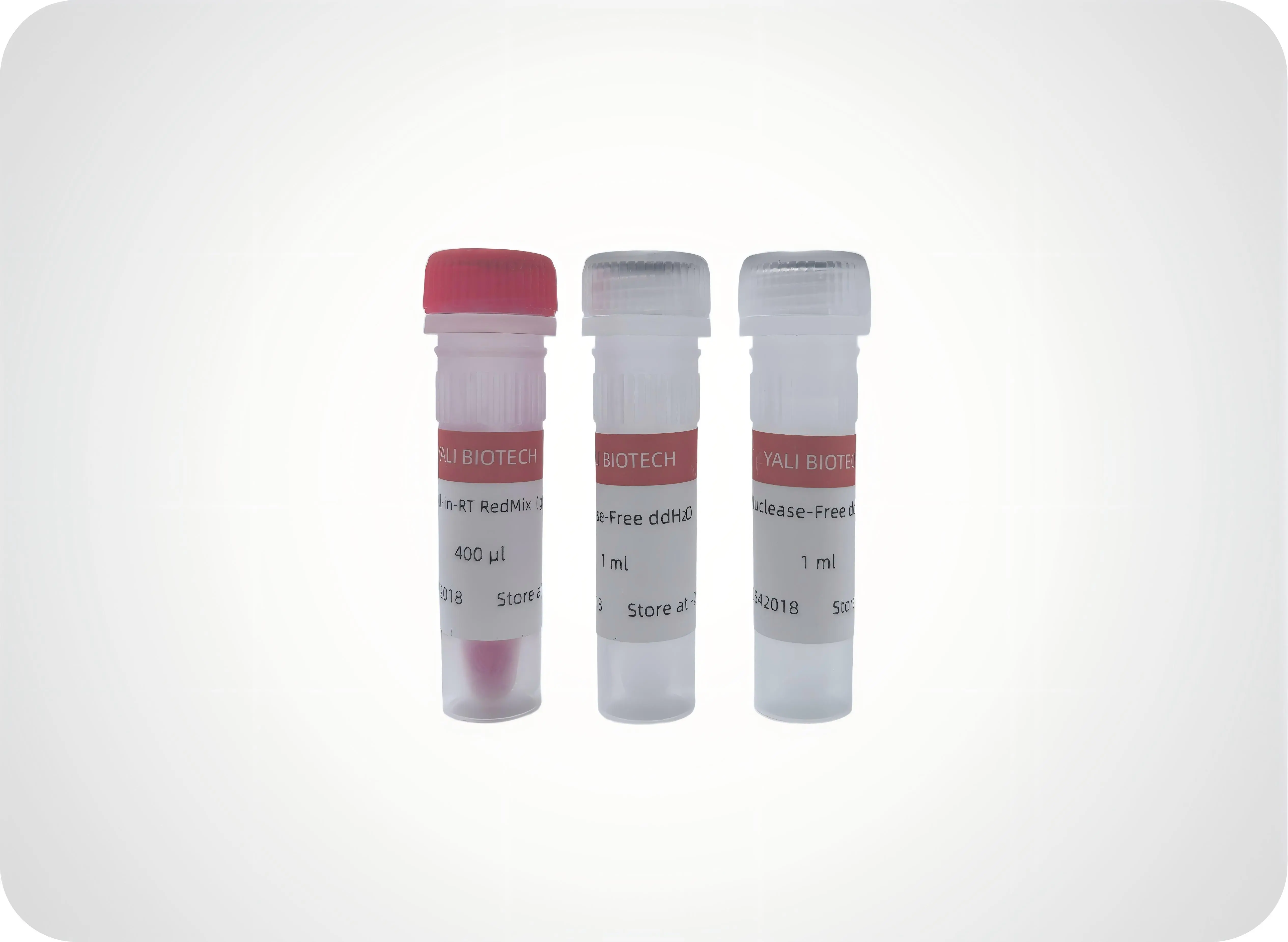
YALEPIC® One-Step gDNA Off and 1st Strand cDNA Synthesis Kit is an 1st Strand cDNA Synthesis Kit (+gDNA wiper), including YALEPIC® Script Reverse Transcriptase and Buffer optimized for reverse transcription, further improving the efficiency of 1st strand synthesis. The kit contains single-component reverse transcription primers Oligo (dT)20VN and Random hexamers, which allows users to choose primers flexibly for subsequent experiments as required. The kit can be used to synthesize full-length cDNA (up to 15 kb) for cloning and other downstream experiments, as well as highly uniform cDNA for qPCR.
Store at -20°C and transport at ≤0°C.
The one-step gDNA removal and first-strand cDNA synthesis kit is an innovative product that simultaneously completes genomic DNA (gDNA) removal and first-strand cDNA synthesis in the same reaction system. Traditional two-step methods require DNase I treatment for gDNA removal first, followed by RNA purification and cDNA synthesis, which is cumbersome and prone to RNA degradation and loss. This product uses a special gDNA Remover with DNA degradation activity (heat-labile dsDNase) that works in concert with a new-generation reverse transcriptase. gDNA removal and cDNA synthesis are completed simultaneously with one-step addition, greatly simplifying the workflow, avoiding sample cross-contamination and RNA degradation risks from multiple pipetting steps, particularly suitable for high-throughput gene expression analysis and trace RNA sample processing.
This kit uses the new-generation YALEPIC Script reverse transcriptase, which can synthesize first-strand cDNA up to 15 kb long in the 50-60 degrees C range (optimal 55 degrees C). High-temperature reverse transcription conditions effectively unwind RNA template secondary structures, making it particularly suitable for reverse transcription of complex RNA templates with high GC content and rich secondary structures (such as RNA with hairpin structures and advanced folding). Compared to conventional reverse transcriptases that react at 37 or 42 degrees C, this product has superior thermal stability, with significantly improved cDNA yield and full-length proportion for complex templates.
No. The heat-labile dsDNase used in this kit specifically degrades double-stranded DNA (genomic DNA) with no activity against single-stranded RNA and single-stranded cDNA. This enzyme rapidly and irreversibly inactivates at 55 degrees C, automatically losing activity after completing gDNA removal. After the reaction, heating at 85 degrees C for 2-5 minutes completely inactivates all enzyme components without any interference with cDNA product stability or subsequent qPCR detection. cDNA processed by this product can be stably stored long-term, qPCR quantification results are reliable, and primer design does not require spanning exon junctions, simplifying experimental design.
This kit provides Oligo(dT)20 and Random Hexamers (N6 random primers) as separate components. Users can flexibly choose or combine them based on experimental needs: Oligo(dT)20 specifically binds to the poly(A) tail of mRNA, suitable for detecting eukaryotic mRNA with poly(A) structure; Random Hexamers randomly bind to various regions of the RNA template, suitable for total RNA, prokaryotic RNA, viral RNA, and non-coding RNA (lncRNA, ncRNA) reverse transcription. Additionally, users can use gene-specific primers (GSP) instead of the above primers for targeted gene reverse transcription. For qPCR detection, mixing Oligo(dT) and Random primers is recommended for more comprehensive cDNA coverage.
The optimal RNA template range for this product is 50 ng to 2 microgram total RNA (20 microL reaction system). If total RNA exceeds 2 microgram, scale up the reaction system proportionally. Due to the high-efficiency performance of the gDNA Remover and reverse transcriptase, the product has excellent compatibility with low-concentration RNA templates – even when the RNA template volume reaches 75%-80% of the total reaction volume, stable and effective reverse transcription efficiency can still be maintained. Therefore, this kit is particularly suitable for gene expression analysis of trace RNA samples (such as small numbers of cells from laser microdissection, rare tissue samples).
The synthesized first-strand cDNA has a wide range of applications: RT-qPCR – compatible with both SYBR Green dye-based and TaqMan probe-based quantitative PCR, with accurate and reliable results; RT-PCR – can be used for conventional PCR amplification of target gene fragments; cDNA library construction – can synthesize full-length cDNA up to 15 kb, suitable for library construction; Gene expression analysis – suitable for both high-copy and low-copy gene detection; Primer extension – for transcription start site analysis; SAGE – for serial analysis of gene expression. The cDNA synthesized by this product can be used for both conventional PCR and qPCR detection, and is particularly recommended for qPCR requiring high-sensitivity quantitative analysis.
This product is recommended for long-term storage at -20 degrees C, avoiding repeated freeze-thaw. Before first use, fully thaw all components, mix well, and centrifuge to collect at the tube bottom before aliquoting. Repeated freeze-thaw causes enzyme activity degradation, affecting reaction efficiency. Aliquoting into small portions (e.g., 10 reactions per aliquot) is recommended, using one aliquot each time. Transport conditions: dry ice or ice pack transport (<0 degrees C), ensuring the product maintains low temperature during transport. Under recommended storage conditions, the shelf life is 12 months.
High Ct values or no signal in qPCR detection typically have the following possible causes and solutions: Poor RNA template quality (degraded or low purity) – use high-quality RNA samples, check A260/A280 and A260/A230 ratios, ensure integrity. RNA template amount too low – adjust RNA input to 50 ng to 2 microgram range. RNA template amount too high (>2 microgram) – scale up the reaction system proportionally, or dilute RNA template appropriately. Improper reverse transcription temperature or time – ensure recommended reaction conditions: 55 degrees C incubation for 15-30 minutes (qPCR) or 30-60 minutes (PCR). qPCR primer design issues – insufficient primer specificity or Tm mismatch; redesign or verify primer specificity. Reaction system not fully mixed – gently flick to mix or briefly vortex after preparation, briefly centrifuge to collect reaction mixture. If problems persist, set up a No-RT Control (without reverse transcriptase) to rule out false positive signals from genomic DNA contamination.
Compared to major competitors, YALI’s core differentiation is that primers are provided as separate individual components. Users can freely adjust the ratio of Oligo(dT) and Random primers, or even replace them with gene-specific primers (GSP), offering flexibility far exceeding competitor pre-mixed formats. This design is particularly suitable for professional research scenarios requiring precise control of primer ratios.
Yes, the reverse transcription MasterMix in this product already contains a highly efficient RNase inhibitor that effectively protects RNA templates from degradation throughout the reaction, ensuring cDNA synthesis integrity and yield. To further ensure RNA stability, users should note the following during experimental operations: Handle on ice throughout – low temperature inhibits RNase activity; Use RNase-free tips, centrifuge tubes, and other consumables; Wear masks and gloves during operation to avoid RNase contamination; RNA samples should avoid repeated freeze-thaw; aliquoting is recommended.




Production center: 4th floor, Building 9, Yangshan Science and Technology
Industrial Park,No. 8 Jinyan Road, Suzhou High-tech Zone
Marketing center: Pujiang High-tech Park, Minhang District, Shanghai
Copyright: 2026 YALI Biotech Co., Ltd.
 Scan to follow us