

A validated kit that simplifies RT-qPCR and gene-expression analysis with consistent, reproducible results.
| Number | Specifications | Catalog Price | Add To Cart |
|---|---|---|---|
| YPM51722 | 100rxns | 1100.00 | + |
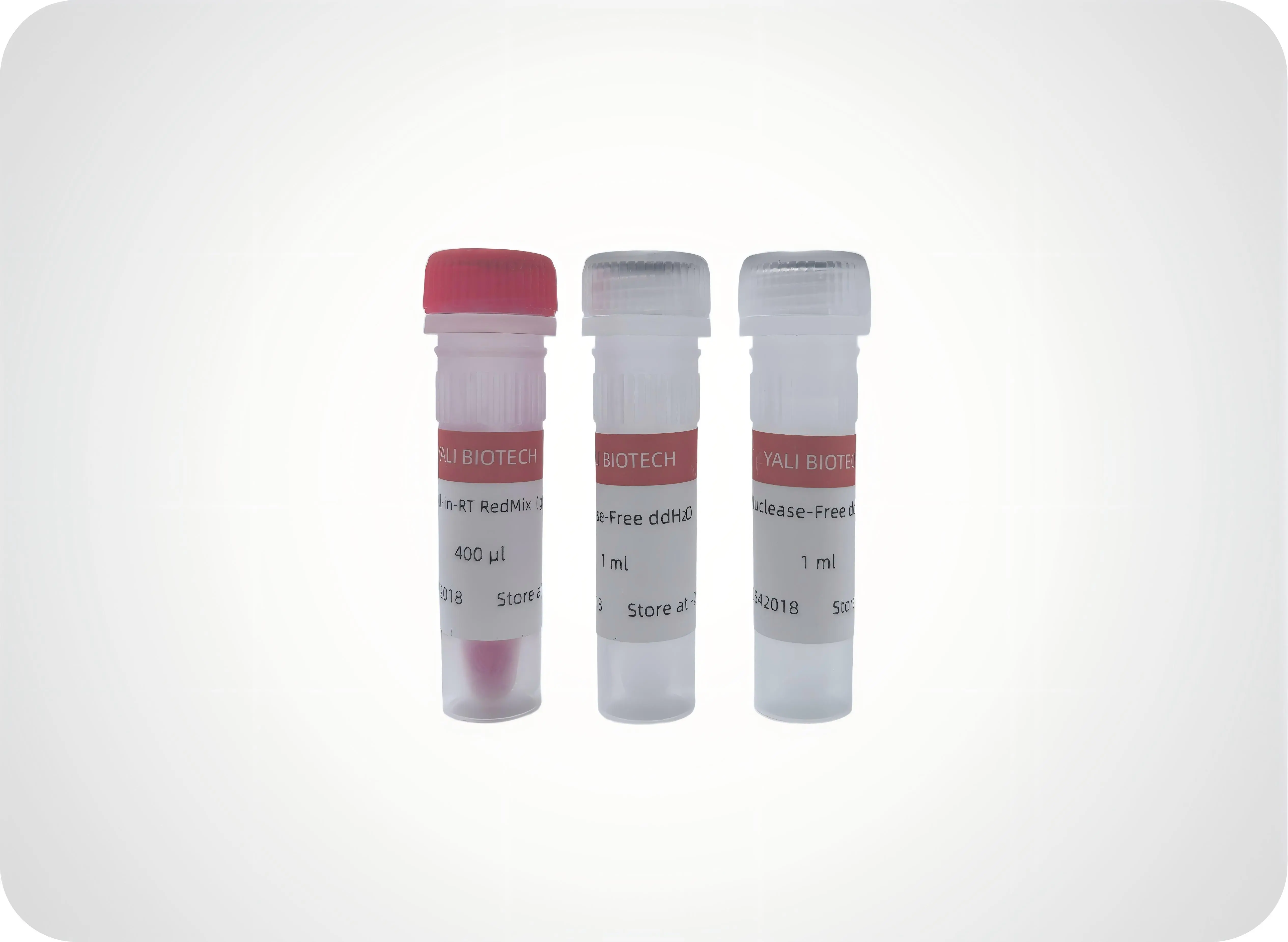
YALEPIC ®All-in-RT RedMix(gDNA off)is an All-in-One SuperMix, utilize the next-generation thermostable reverse transcriptase YALEPIC® Script Reverse Transcriptase Plus and an optimized reaction buffer to for reverse transcription,further improving the efficiency of 1st strand synthesis. within 30 minutes across a broad temperature range (45–60°C). Integrated thermolabile dsDNase specifically eliminates double-stranded DNA while maintaining cDNA integrity, allowing synchronous genomic DNA removal and reverse transcription. Reactions proceed rapidly upon addition of only template RNA and nuclease-free water. The synthesized first-strand cDNA is immediately suitable for downstream applications including library construction, PCR, qPCR, and hybridization assays.
Store at -20°C and transport at ≤0°C.
In RT-qPCR experiments, residual genomic DNA in RNA samples is the most hidden and destructive source of contamination. gDNA is highly homologous to cDNA sequences and will be non-specifically amplified by qPCR primers, leading to false positive results. Low-expression genes (with higher Ct values) are particularly susceptible to gDNA contamination interference. If amplification products appear in the control tube without reverse transcriptase, it indicates that residual gDNA must be removed from the RNA sample.
Traditional two-step methods require DNase I treatment of the RNA template first, then 85 degrees C heat inactivation, and finally adding reverse transcription components for reverse transcription, which is cumbersome and takes about 30 minutes. The one-step method completes gDNA removal and reverse transcription in the same tube simultaneously – simply add template RNA and water to start the reaction quickly, greatly simplifying operations and avoiding sample contamination and RNA degradation risks during complex pipetting.
Regular DNase I also has significant degradation activity against single-stranded DNA, which may affect primer and probe stability. The heat-labile dsDNase specifically digests double-stranded DNA with no activity against single-stranded DNA, primers, probes, or RNA, ensuring cDNA integrity. Additionally, this enzyme irreversibly inactivates within 5 minutes at 55 degrees C, requiring no additional heat inactivation step.
No. The red tracking dye in the product has been carefully optimized and will not interfere with fluorescence signal acquisition in downstream dye-based or probe-based qPCR, ensuring that amplification sensitivity and plateau are not affected.
This product is suitable for RNA templates from various species and sample types. The new-generation reverse transcriptase has excellent high-temperature stability and complex template read-through capability, particularly suitable for reverse transcription of RNA templates with high GC content, complex secondary structures, and low-concentration RNA samples.
The recommended RNA template amount is 500 ng to 1 microgram (total RNA). Verified testing shows that this product can stably amplify total RNA in the range of 10 pg to 1 microgram, suitable for low-abundance gene detection.
This can be verified by setting up a No-RT Control (No Reverse Transcriptase Control): omit the reverse transcriptase from the reaction system while adding all other components normally, then perform qPCR detection. If no amplification signal appears in the No-RT control tube, it indicates that gDNA has been successfully removed.
Long-term storage at -20 degrees C is recommended, with transport at <0 degrees C. After use, promptly return to -20 degrees C storage to maintain enzyme activity. Avoid repeated freeze-thaw; aliquoting is recommended.
The synthesized first-strand cDNA can be widely used in library construction, conventional PCR, qPCR (dye-based and probe-based), hybridization, and other molecular biology experiments.
This product can perform reverse transcription reactions in the 45-60 degrees C range. For RNA templates with complex secondary structures or high GC content, appropriately increasing the reaction temperature (e.g., 55 degrees C) is recommended to improve amplification efficiency and sensitivity.



Production center: 4th floor, Building 9, Yangshan Science and Technology
Industrial Park,No. 8 Jinyan Road, Suzhou High-tech Zone
Marketing center: Pujiang High-tech Park, Minhang District, Shanghai
Copyright: 2026 YALI Biotech Co., Ltd.
 Scan to follow us