

| Number | Specifications | Catalog Price | Add To Cart |
|---|---|---|---|
| YC22016 | 50T | Online Consult | + |
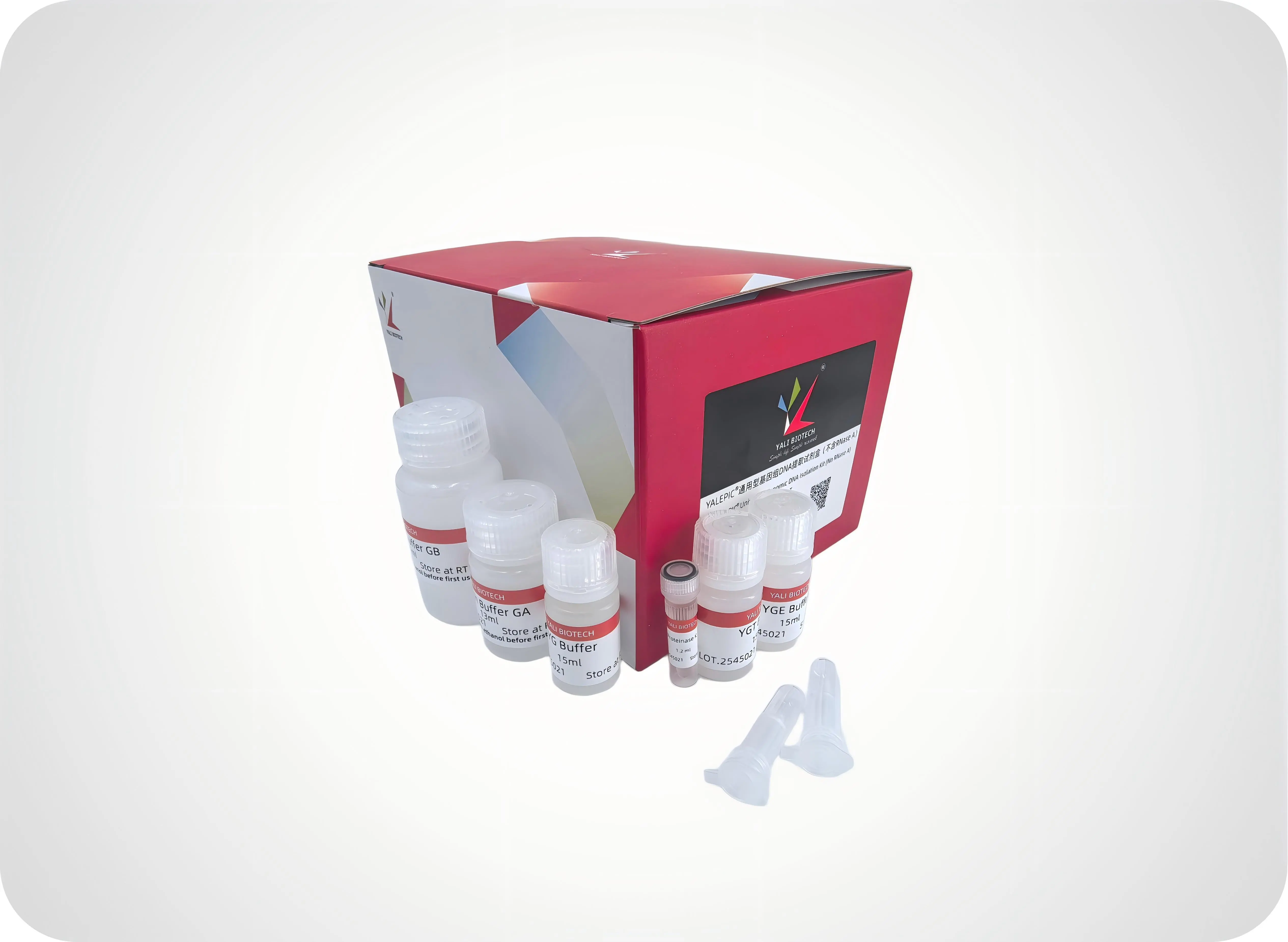
YALEPIC® Universal Genomic DNA Isolation Kit(No RNase A) is suitable for extracting genomic DNA from ≤200 μl of fresh or frozen anticoagulated whole blood, <25 mg of animal tissues, <5 × 10⁶ of cultured cells and <3 × 10⁹ cultured bacterial samples. The kit is based on silica gel column purification technology. With this kit, RNA, proteins, lipids and other inhibitory impurities can be removed at the greatest extent. The DNA obtained can be directly used in PCR, qPCR, enzyme digestion and detection.
≤200 μl of fresh or frozen anticoagulated whole blood, <25 mg of animal tissues, <5 × 10⁶ of cultured cells , <3 × 10⁹ cultured bacterial samples.
Store at 10 ~ 30°C in a dry place for one year and transport at room temperature.
We suggest storing Proteinase K at 2 ~ 8°C.
DNA yield varies by sample type and amount. Typically: 3-6 micrograms from 200 microL healthy whole blood; 10-30 micrograms from 25 mg animal tissue (e.g., liver); 15-40 micrograms from 5 x 10^6 cultured cells (e.g., HEK293). We recommend reviewing literature for target sample DNA content before experiments.
This is a universal kit with an optimized lysis buffer system suitable for various biological samples. Besides tissues, blood, and cells, it can effectively process bacteria (E. coli) and fungi (yeast). For plant tissues, FFPE (formalin-fixed paraffin-embedded) samples, and other special cases, it is not recommended.
DNA degradation relates to sample handling and operation. First, use freshly collected or properly frozen samples, avoiding repeated freeze-thaw (a major cause of nuclease-mediated DNA degradation). Second, insufficient lysis affects DNA integrity – ensure thorough tissue grinding and even mixing with lysis buffer. After extraction, aliquot DNA and store at -20 degrees C to avoid repeated freeze-thaw.
Common causes: Sample itself – low DNA content (low white blood cell count, over-cultured bacteria) or degradation from improper storage. Insufficient lysis – tissue pieces too large, proteinase K inactivated or insufficient incubation. Extend 56 degrees C incubation (overnight for difficult samples) and check proteinase K activity. Reagent issues – forgot to add ethanol to wash buffer (a common beginner mistake). Elution issues – pre-warm elution buffer to 60-70 degrees C, apply to membrane center, incubate 1-5 minutes before centrifugation, or perform double elution.
Purity is critical for downstream experiments: Low OD260/280 (below 1.9) indicates RNA residue. Add 4 microL RNase A (100 mg/mL) before proteinase K, incubate at room temperature for 5 minutes. DNA difficult to dissolve may indicate over-drying of precipitate. Air dry only, no more than 5 minutes, avoid vacuum drying.
Mainly due to inhibitor residues such as ethanol or salt ions in purified DNA. Solutions: spin empty column at max speed for 2-3 minutes after washing to thoroughly dry the column; ensure ethanol has been added to solutions as indicated on bottles. If DNA is impure, increase wash cycles or add BSA to PCR at 0.1 microgram/microL to mitigate inhibition.
Column clogging is typically caused by insufficient lysis or excessive sample input. Try: extend lysis time and increase inversion mixing; reduce starting sample amount; ensure lysate is completely clear before centrifugation.
The kit is very stable and can be stored and transported at room temperature (15-25 degrees C) with a shelf life of 18 months. Proteinase K (if in powder or solution form) should be aliquoted and frozen per protocol to avoid repeated freeze-thaw. No special cold storage needed, providing great convenience for daily laboratory use.




Production center: 4th floor, Building 9, Yangshan Science and Technology
Industrial Park,No. 8 Jinyan Road, Suzhou High-tech Zone
Marketing center: Pujiang High-tech Park, Minhang District, Shanghai
Copyright: 2026 YALI Biotech Co., Ltd.
 Scan to follow us