
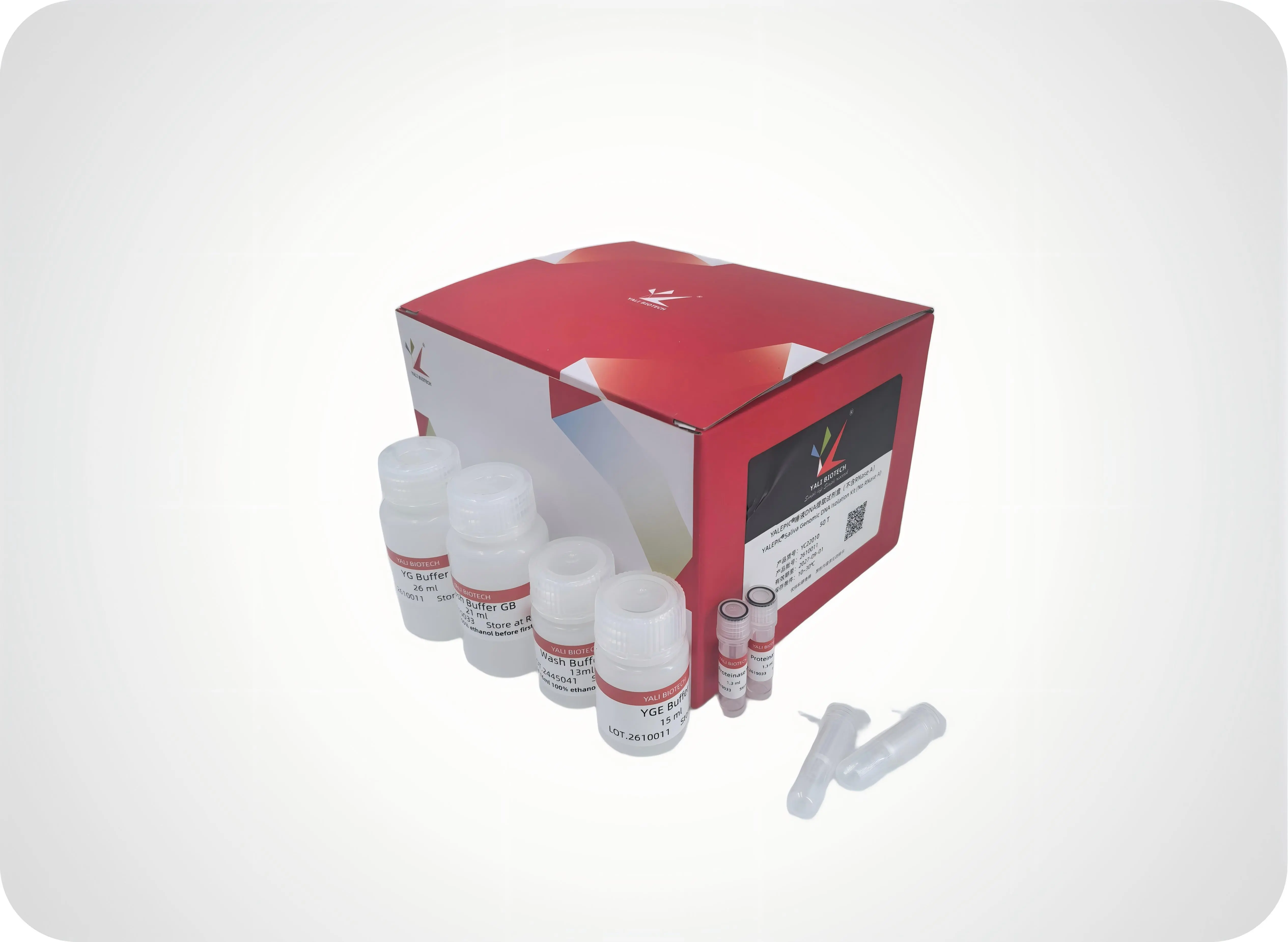
An optimized magnetic bead workflow that turns saliva into high-quality genomic DNA ready for downstream applications.
| Number | Specifications | Catalog Price | Add To Cart |
|---|---|---|---|
| YC22010 | 50T | Online Consult | + |
YALEPIC® Saliva Genomic DNA Isolation Kit(No RNase A) is optimized to isolate Genomic DNA from saliva/preservative solution mixtures. Samples are lysed by unique lysis buffer. DNA is bound to silica-based column and eluted by Elution Buffer . The purified DNA is suitable for PCR, qPCR, restriction enzyme digestion, and other molecular biology applications.
Safe and non-toxic: Use eco-friendly and non-toxic agents instead of traditional one.
High quality and good integrity: The extracted DNA has the characteristics of high yield, good purity and complete fragments.
Saliva/preservative solution mixtures
Transport at room temperature.
Storage at 10 ~ 30°C for one year.
When collecting saliva samples, please note the following: Avoid eating, drinking, smoking, or chewing gum for 30 minutes before collection to prevent affecting DNA quality; Rinse the mouth gently with clean water before collection to remove food residues; Collect 200-500 microL of fresh saliva as the starting sample volume (can be adjusted according to experimental needs); If extraction cannot be performed immediately after collection, mix saliva with saliva preservation fluid at the recommended ratio (typically 1:1), room temperature storage for weeks to months without affecting DNA quality; Avoid excessive bubbles in the saliva, as bubbles may cause inaccurate sample volume measurement.
The kit’s optimized buffer system can process 200-500 microL of saliva samples, with a recommended standard volume of 400 microL. For trace samples (below 200 microL), it is recommended to bring the volume up to standard with saliva preservation fluid or PBS before extraction, or proportionally reduce reagent volumes as instructed in the manual. For extremely trace samples (less than 50 microL), a DNA extraction kit specifically designed for trace samples is recommended. For further guidance, please contact YALI Biotech technical support.
Yes. The saliva genomic DNA extracted with this kit undergoes rigorous washing steps to thoroughly remove proteins, polysaccharides, lipids, and other PCR inhibitors. The A260/A280 ratio is typically 1.7-2.0, A260/A230 ratio >1.8, and DNA fragment size >15 kb, fully meeting the quality requirements for NGS library construction (such as Illumina, MGI platforms). Users have successfully completed whole-exome sequencing library construction and sequencing using saliva gDNA extracted with this product. For NGS applications, accurate DNA concentration quantification before library construction is recommended (Qubit fluorometry is recommended).
This kit is specifically designed for saliva samples but is also suitable for DNA extraction from oral swab samples. For swab samples, cut the swab head into a centrifuge tube, add lysis buffer and proteinase K, and vortex thoroughly to release cells. Subsequent steps are identical to the saliva sample protocol. For high-throughput extraction specifically designed for swab samples, please refer to other YALI Biotech nucleic acid extraction product lines.
This kit does not contain RNase A by default for the following reasons: (1) Some downstream applications (such as simultaneous DNA and RNA analysis, RNA interference studies, etc.) require preserving the RNA component during extraction; (2) A kit without RNase A provides greater experimental flexibility, allowing users to choose whether to add RNase A based on actual needs. If you need to remove RNA: Add an appropriate amount of RNase A solution (not provided with the kit, needs to be prepared or purchased separately) to the sample after the lysis step, incubate at 37 degrees C for 15-20 minutes, then continue with subsequent steps. If you need to preserve RNA while extracting DNA for downstream detection, a kit specifically designed for DNA/RNA co-extraction is recommended.
This kit can be stably stored for 12 months at 10-30 degrees C room temperature when unopened. After opening, all components can be used until the labeled expiration date under proper storage conditions (lysis buffer, wash buffer, and elution buffer at room temperature; proteinase K recommended at -20 degrees C). Tighten caps immediately after each use to prevent contamination and reagent evaporation. After opening Wash Buffer 2 concentrate, immediately add the specified volume of anhydrous ethanol, mark the date of ethanol addition, store at room temperature after adding ethanol, and use within 6 months. Refer to the product packaging label for the exact expiration date.
This kit includes an optimized wash system that effectively removes proteins, polysaccharides, and other enzymatic reaction inhibitors through two wash steps. The extracted DNA can be directly used for PCR, qPCR, and other enzymatic reactions without additional purification. To verify the presence of PCR inhibitors, the following methods can be used: (1) Internal reference amplification control method: Mix a known concentration of standard DNA template with an equal amount of extracted DNA for PCR amplification and compare amplification efficiency; (2) A260/A230 ratio method: A260/A230 ratio <1.8 suggests possible guanidine salt, polysaccharide, or other inhibitor residue; (3) Concentration gradient dilution method: Serially dilute the extracted DNA for PCR and observe whether the amplification curve shows a linear relationship.
This kit is designed for manual operation based on the spin column method, suitable for small-to-medium throughput sample processing (50-prep specification). For high-throughput automated extraction solutions, YALI Biotech offers the magnetic bead-based saliva genomic DNA extraction kit YALEPIC MagEVO Saliva DNA Extraction Kit CAT#YM26010. Please visit the YALI Biotech website or contact sales for detailed information.
The purified saliva genomic DNA can be stored long-term under the following conditions: -20 degrees C storage: Dissolved in elution buffer or nuclease-free water, can be stored for 6-12 months, suitable for medium-to-short-term storage; -80 degrees C storage: Can be stored long-term (several years), aliquoting into small tubes is recommended to avoid DNA degradation from repeated freeze-thaw; 4 degrees C short-term storage: DNA to be used within 3-5 days after extraction can be temporarily stored at 4 degrees C.
For low-abundance DNA saliva samples (such as from elderly individuals, Sjogren’s syndrome patients, long-term medication users, etc.), the following optimization measures can be tried to improve yield: (1) Increase starting sample volume: Appropriately increase the saliva sample volume to 600-800 microL, provided the spin column capacity (typically <=30 microgram DNA) is not exceeded; (2) Optimize lysis time: Extend the lysis step to 15-20 minutes, and if necessary, increase the lysis temperature to 65 degrees C; (3) Reduce elution volume: Use 50 microL (instead of 100 microL) of elution buffer to increase DNA concentration; (4) Double elution and combine: Elute twice with 30-40 microL of elution buffer and combine the DNA solution from the collection tube; (5) Pre-warm elution buffer: Pre-warm the elution buffer to 65-70 degrees C before adding to the adsorption column to improve elution efficiency; (6) Extend elution incubation time: After adding elution buffer, let stand at room temperature for 2-5 minutes before centrifugation to ensure complete DNA dissolution.
Yes. This kit is explicitly labeled as suitable for genomic DNA extraction from saliva/preservation fluid mixture samples. Commercial saliva preservation fluids typically contain components that stabilize cell membranes and inhibit nuclease activity, and are compatible with the kit’s lysis buffer system. It is recommended to consult the preservation fluid supplier before use to confirm compatibility with this kit. For untested preservation fluid brands, a pilot experiment with a small sample is recommended for verification.




Production center: 4th floor, Building 9, Yangshan Science and Technology
Industrial Park,No. 8 Jinyan Road, Suzhou High-tech Zone
Marketing center: Pujiang High-tech Park, Minhang District, Shanghai
Copyright: 2026 YALI Biotech Co., Ltd.
 Scan to follow us