


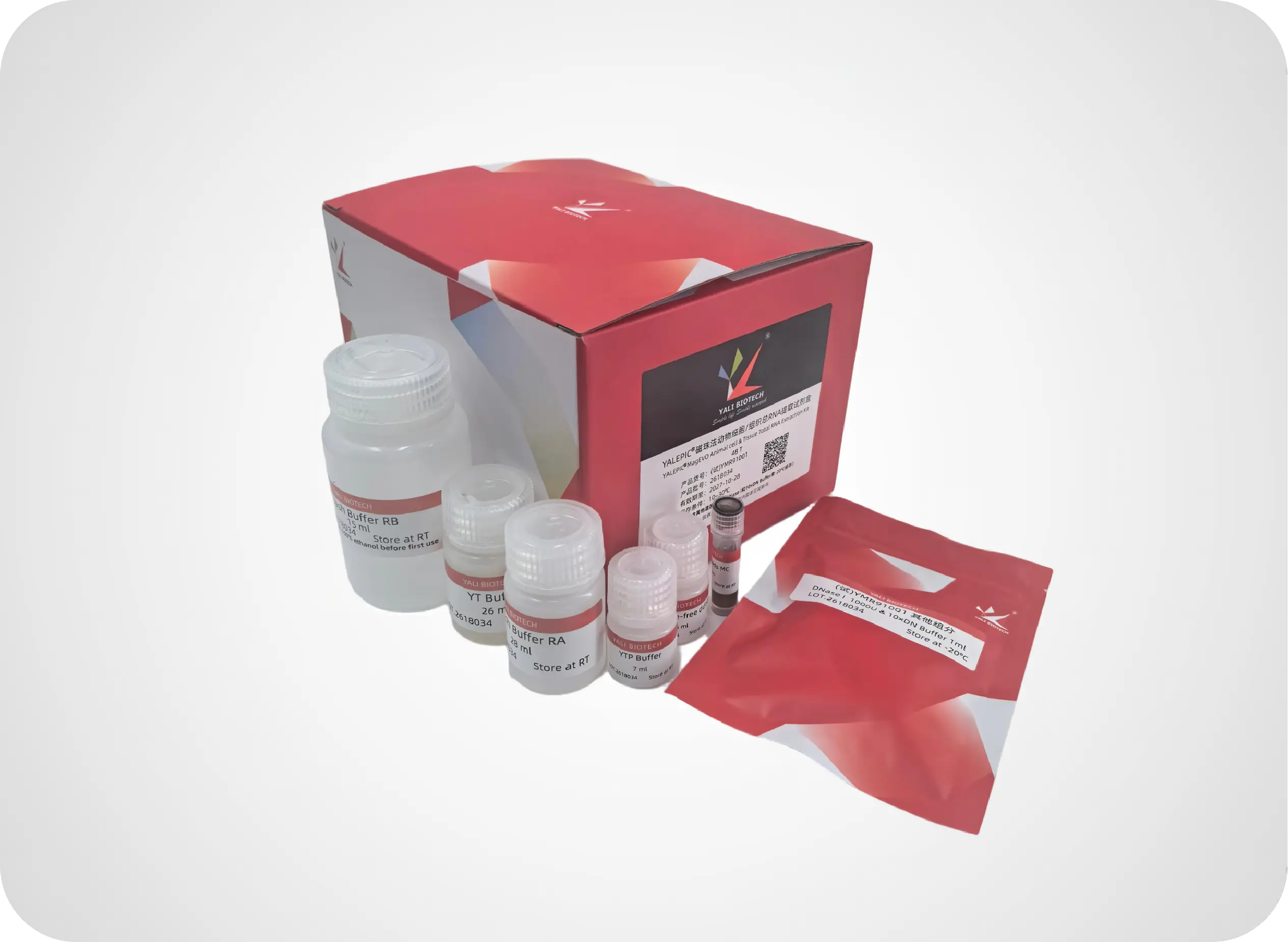
An optimized magnetic bead workflow that turns animal tissues and cells into high-quality total RNA ready for downstream applications.
| Number | Specifications | Catalog Price | Add To Cart |
|---|---|---|---|
| YMR91001 | 96T | Online Consult | + |
| YMR91001-A (Prepackaged) | 32T | Online Consult | + |
| YMR91001-B(Prepackaged) | 48T | Online Consult | + |
| YMR91001-C(Prepackaged) | 96T | Online Consult | + |
YALEPIC® MagEVO Animal Cell & Tissue Total RNA Extraction Kit is used to extract high-purity RNA from cells and animal tissues, achieving high-throughput processing of samples. The kit is based on superparamagnetic particle purification technology and a unique reagent system, which can effectively remove various impurities and specifically adsorb nucleic acids. The obtained RNA can be directly used for molecular biology experiments such as RT-PCR, qRT-PCR, Northern Blot, Dot Blot, in vitro translation, and high-throughput sequencing. The automated operation process is simple, fast, and safe.
Get high quality RNA in animal tissues (<30 mg) , cells (1×10⁴ – 5×10⁶).
DNase I transport and storage at -20℃ for one year.
Others at room temperature (10℃- 30℃) for one year. Transport at room temperature.
RNA degradation is typically caused by the following: Improper sample preservation – animal tissues not frozen or placed in lysis buffer promptly after excision, leading to activation of endogenous RNases. It is recommended to snap-freeze in liquid nitrogen immediately after sampling or directly homogenize in the lysis buffer provided with the kit. RNase contamination – tips, tubes, pipettes, and work surfaces used during the experiment may introduce exogenous RNase. Use RNase-free certified consumables, wear gloves and change them frequently, and prepare reagents with DEPC-treated water. Repeated freeze-thaw of samples – multiple freeze-thaw cycles destroy RNA integrity. Aliquot samples for storage and avoid repeated freeze-thaw. Vigorous operation – excessive vortexing or pipetting may cause mechanical RNA shearing. Mix gently by flicking after lysis and pipette gently.
Low RNA yield can be investigated and optimized from the following aspects: Insufficient sample input – confirm that animal tissue usage is within 15-25 mg and cultured cells within 1×10^6 to 1×10^7. Too little sample will result in low total RNA. Incomplete lysis – for animal tissue, grind to powder in liquid nitrogen before adding lysis buffer, or use an electric homogenizer for thorough homogenization. For cultured cells, pipette thoroughly after adding lysis buffer until cells are completely lysed with no visible clumps. Magnetic bead wash loss – during magnetic separation washing, ensure beads are fully adsorbed by the magnetic rack before discarding the supernatant to avoid aspirating beads. Carefully remove supernatant with a pipette without disturbing the beads. Elution condition optimization – after adding elution buffer, incubate at room temperature for 2-5 minutes. If needed, heat at 55-65 degrees C for 2-3 minutes to enhance elution efficiency. A second elution may be performed if necessary to improve recovery.
The A260/A280 ratio is an important indicator for assessing RNA purity: Ratio below 1.9 – usually indicates protein contamination. Ensure thorough lysis, add an extra wash step, and verify lysis buffer adequately covers all sample material. Ratio above 2.1 – usually indicates RNA degradation or residual salt ions. Recommendations: follow the RNA degradation solutions in the previous question; ensure magnetic beads are adequately dried after washing (briefly centrifuge and aspirate residual wash buffer with a pipette) to avoid ethanol residue affecting the reading. Ideally, high-quality RNA should have an A260/A280 ratio between 1.9 and 2.1.
The MagEVO animal cell/tissue total RNA extraction kit incorporates an on-column/on-bead DNase I digestion step that effectively removes residual genomic DNA. Specific recommendations: DNase I digestion – follow the protocol: after magnetic beads bind RNA, add DNase I reaction mix for on-column/on-bead digestion, ensuring sufficient digestion time (typically 15 minutes at room temperature). DNase I inactivation – wash thoroughly after digestion to remove DNase I and its reaction products, avoiding inhibition of downstream reverse transcriptase. Primer design strategy – if the experiment is extremely sensitive to DNA carryover (e.g., detecting low-abundance genes or limited intron-spanning primer design), design exon-spanning primers or use DNase I-treated RNA as template with a ‘No-RT’ (no reverse transcriptase) control to monitor DNA carryover.
MagEVO pre-filled reagent plates provide a ready-to-use, convenient experience: Product format – pre-filled models A/B/C are 32T/48T/96T pre-dispensed plate reagents. Magnetic beads, lysis buffer, wash buffer, and elution buffer are all pre-arranged in a 96-well plate per the protocol. Users only need to add pre-treated samples before loading onto the instrument. Compatible instruments – this product has been extensively validated and is compatible with mainstream automated nucleic acid extractors, including but not limited to: YALI BIOTECH YALEPIC Pure series automated extractors, Thermo Scientific KingFisher series, and magnetic rod-based extractors from Tianlong, Bioer, and Aosheng. Contact YALI BIOTECH technical support for specific run programs. Key operational points – before using the pre-filled plate, remove the sealing film and check that reagent volumes in each well are intact. Transfer lysed samples to the sample wells and run according to the instrument program. After the run, collect the RNA solution from the elution wells, aliquot and store at -80 degrees C, or use directly for downstream experiments.
Compared with the traditional TRIzol/chloroform method, the MagEVO magnetic bead method offers the following significant advantages: Experimental time – 40 minutes vs. 60 minutes. Organic solvent use – no toxic reagents such as chloroform or isopropanol needed throughout. Operation steps – simplified magnetic separation vs. multiple centrifugation and phase separation steps. Automation compatibility – supports automated extractors for high-throughput vs. difficult to automate. Nucleic acid purity – no organic solvent residue risk, high purity. RNase protection – closed-system operation, RNA is more stable vs. higher exposure risk during the process. Therefore, for laboratories pursuing operational efficiency, experimental safety, and high-throughput processing, the MagEVO magnetic bead-based RNA extraction kit is the more ideal choice.
Different kit components have different storage requirements. Please strictly follow the instructions below: Components stored at -20 degrees C – DNase I and 10x DNase Buffer. After arrival under low-temperature shipping, if not used immediately, store at -20 degrees C. After dissolving DNase I, aliquot into single-use volumes to avoid repeated freeze-thaw which reduces enzyme activity. Components stored at room temperature – magnetic bead suspension, lysis buffer, wash buffer, elution buffer, and all other components can be stored long-term at 10-30 degrees C. Avoid high temperatures (>40 degrees C) or direct sunlight. Special note – after opening the kit, store components separately according to the above conditions and use within the labeled expiration date. If long-unused DNase I shows precipitation or activity decline, replace with a new batch.
The MagEVO animal cell/tissue total RNA extraction kit delivers good extraction results for routine tissue samples. For high-fat-content special samples, the following optimization measures are recommended: Increase lysis buffer volume – lipid components in adipose tissue may interfere with nucleic acid binding efficiency of magnetic beads. For 15-25 mg adipose tissue, increase lysis buffer volume to 500-600 microL (vs. 400 microL standard). Strengthen lysis operations – adipose tissue is recommended to be thoroughly ground to powder in liquid nitrogen, or use a handheld homogenizer in lysis buffer at high speed for 30-60 seconds to ensure complete tissue dispersion. Increase wash steps – after magnetic separation, add an extra wash step with Wash Buffer I to more thoroughly remove residual lipid components. Ensure lysis buffer fully infiltrates – ensure lysis buffer completely covers the tissue powder, mix thoroughly and lyse at room temperature for 5-10 minutes. If needed, heat at 65 degrees C for 5 minutes to assist lysis.
Next-generation sequencing has high requirements for RNA starting quality, mainly in the following aspects: Purity requirements – A260/A280 ratio should be between 1.9-2.1, A260/A230 ratio >=2.0, free of guanidine salts, ethanol, detergent residues, etc. RNA extracted with the MagEVO kit, after stringent washing, is free of these contaminants and fully meets NGS library construction requirements. Integrity requirements – RIN (RNA Integrity Number) should be >=8, with 28S band brightness approximately twice that of 18S band on electrophoresis. The RIN value of RNA extracted with MagEVO, tested by Agilent Bioanalyzer, can reach above 8.5. No DNA carryover – trace DNA carryover may be erroneously counted in transcript quantification results. This product includes DNase I digestion, effectively eliminating gDNA contamination. Recommended input – NGS library construction typically requires 100 ng to 1 microgram of total RNA, corresponding to the cell/tissue input range recommended for this product. Adjust sample starting amount according to specific library preparation kit requirements.
The superparamagnetic nano-magnetic beads used in the MagEVO series have undergone special surface modification and suspension formulation optimization, with the following characteristics: Long-term stability – under recommended 10-30 degrees C room-temperature storage, the magnetic bead suspension is stable for over 12 months. Before use, vortex thoroughly or invert to mix, ensuring magnetic beads are uniformly dispersed before taking aliquots. Anti-aggregation performance – the hydrophilic surface modification and suspension stabilizer formulation used in this product effectively prevent irreversible aggregation of beads after long-term static storage. If slight sedimentation is observed, mixing restores uniform suspension. Usage precautions – do not freeze the magnetic bead suspension; freezing destroys suspension stability and causes bead aggregation. Mix thoroughly before each use and cap tightly immediately after use to avoid dust and RNase contamination.




Production center: 4th floor, Building 9, Yangshan Science and Technology
Industrial Park,No. 8 Jinyan Road, Suzhou High-tech Zone
Marketing center: Pujiang High-tech Park, Minhang District, Shanghai
Copyright: 2026 YALI Biotech Co., Ltd.
 Scan to follow us