


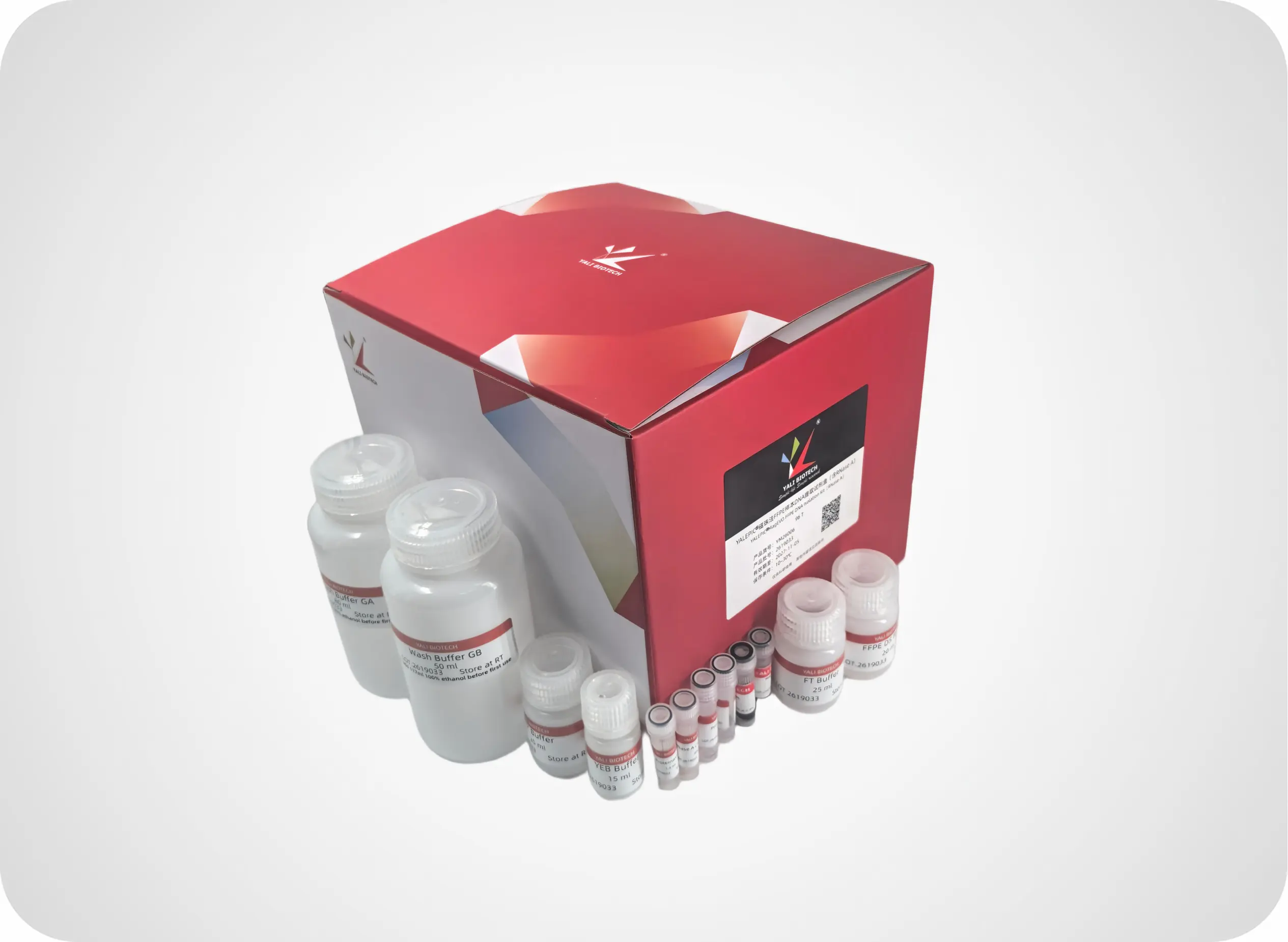
An optimized magnetic bead workflow that turns FFPE tissue into high-quality genomic DNA ready for downstream applications.
| Number | Specifications | Catalog Price |
|---|---|---|
| YM26006 | 96T | Online Consult |
| YM26006-A (Prepackaged) | 32T | Online Consult |
| YM26006-B (Prepackaged) | 48T | Online Consult |
| YM26006-C (Prepackaged)) | 96T | Online Consult |
YALEPIC® MagEVO FFPE DNA Extraction Kit employs a safe, non-toxic, and environmentally deparaffinization solution along with an efficient lysis/de-crosslinking reagent, which can lyse and release trace DNA in paraffin embedded sections and tissues. The high-affinity magnetic beads used in the kit can adsorb nucleic acids in a high-salt buffer and release nucleic acids in a low-salt elution buffer, thereby achieving rapid separation and purification of nucleic acids. The obtained products has good integrity and amplifiability, suitable for downstream applications such as PCR, next-generation sequencing, hybridization capture, etc. This kit can be used with automated nucleic acid extraction instrument for high-throughput extraction.
Paraffin tissue sections: 5–8 pieces (5–10 μm thick, 1 cm × 1 cm size, < 20 mg).
Transport at room temperature.
Storage at 10 ~ 30°C for one year.
If ambient temperatures often exceed 30°C, we suggest storing Proteinase K and Magbeads PM at 2 ~ 8°C (protect from freezing).
FFPE stands for Formalin-Fixed, Paraffin-Embedded, which is the standard method for long-term preservation of tissue samples in pathology. Massive FFPE biological sample resources have been accumulated over the past decades, containing rich disease information. The core challenges of DNA extraction from FFPE samples are: (1) During formalin fixation, formaldehyde cross-links with DNA and proteins, chemically ‘locking’ the DNA. (2) Long-term room-temperature storage further accelerates DNA degradation and fragmentation. (3) The deparaffinization process, if using organic solvents such as xylene, may damage the sample during paraffin embedding removal. (4) Sample quantity is typically extremely limited and precious. The YALEPIC MagEVO kit effectively addresses these challenges through optimized lysis conditions and de-crosslinking steps, achieving efficient extraction of high-quality DNA from precious FFPE samples.
Yes. The DNA extracted with the YALEPIC MagEVO kit is of high purity and good fragment integrity, fully compatible with NGS library preparation workflows. Test data show that the A260/A280 ratio of the extraction product is between 1.8-2.0, and PCR inhibitors are effectively removed, ensuring library construction efficiency and sequencing data quality for downstream sequencing. It is recommended to use a Qubit fluorometer for accurate quantification before NGS library preparation.
Absolutely. The DNA extracted with the MagEVO kit has removed amplification inhibitors caused by formalin cross-linking, and the extraction product can be directly used for qPCR and Real-time PCR detection. Thanks to the efficient de-crosslinking step, amplification product length can reach 1 kb, providing stable and reliable performance in gene expression quantification and mutation detection.
Not at all. The YALEPIC MagEVO kit uses an innovative non-toxic chemical deparaffinizing agent to replace traditional xylene. The entire extraction process involves no toxic organic solvents, posing no health hazard to laboratory personnel and requiring no special fume hood equipment. This not only ensures laboratory safety but also avoids tissue shrinkage, hardening, and embrittlement that xylene may cause, while aligning with the concept of green and environmentally friendly laboratory construction.
Using the YALEPIC MagEVO kit to extract DNA from FFPE tissue sections, the entire operation workflow takes approximately 30-40 minutes. No overnight incubation is required, saving significant time compared with traditional overnight digestion methods and greatly improving laboratory work efficiency.
This kit can be shipped and stored at 10-30 degrees C ambient temperature, without the need for cold chain or special refrigeration equipment, reducing logistics and storage costs. Do not freeze any kit components. Before use, mix thoroughly. Room-temperature storage shelf life is up to 24 months.
It is recommended to use 5-8 FFPE tissue sections with a thickness of 5-10 microM, with a total section area of approximately 1×1 cm2 and total tissue amount not exceeding 20 mg. Section thickness is recommended to be controlled within 20 microM. For different tissue types, the number of sections can be appropriately adjusted based on tissue cell density.
DNA yield depends on multiple factors, including tissue source, sample storage time, fixation conditions, and section thickness. Under optimized conditions, 2-8 microgram of genomic DNA can be extracted from 5-8 FFPE sections of 5-10 microM thickness. There are differences among tissue types, with tumor tissue typically yielding higher amounts and fibrotic tissue yielding relatively lower amounts.
The following methods are recommended for quality testing: Concentration detection – use a Qubit fluorometer with dsDNA HS assay kit for specific quantification of double-stranded DNA without RNA or protein interference. YALEPIC 1x dsDNA high-sensitivity assay kit CAT#YNQ24091 is available. Purity assessment – use a NanoDrop spectrophotometer to detect the A260/280 ratio, with the ideal range being 1.8-2.0. Integrity analysis – for high-demand applications such as NGS, use a bioanalyzer for DNA fragment distribution analysis.
It is recommended to aliquot and store the purified DNA at -20 degrees C, avoiding repeated freeze-thaw. Under -20 degrees C conditions, it can be stably stored for at least 2 years. For long-term archiving, -80 degrees C ultra-low temperature storage is recommended. Use nuclease-free (DNase/RNase-free) storage tubes and avoid prolonged exposure of DNA solution at room temperature.
The YALEPIC MagEVO kit uses magnetic bead-based purification technology and is fully compatible with mainstream automated nucleic acid extractors on the market. The magnetic bead-based automated workflow can significantly improve throughput and result reproducibility compared with manual operation.




Production center: 4th floor, Building 9, Yangshan Science and Technology
Industrial Park,No. 8 Jinyan Road, Suzhou High-tech Zone
Marketing center: Pujiang High-tech Park, Minhang District, Shanghai
Copyright: 2026 YALI Biotech Co., Ltd.
 Scan to follow us