
An optimized spin column workflow that turns plasmid from 30–50 mL culture (custom) into high-quality plasmid DNA ready for downstream applications.
| Number | Specifications | Catalog Price | Add To Cart |
|---|---|---|---|
| YC47008 | 15T | Online Consult | + |
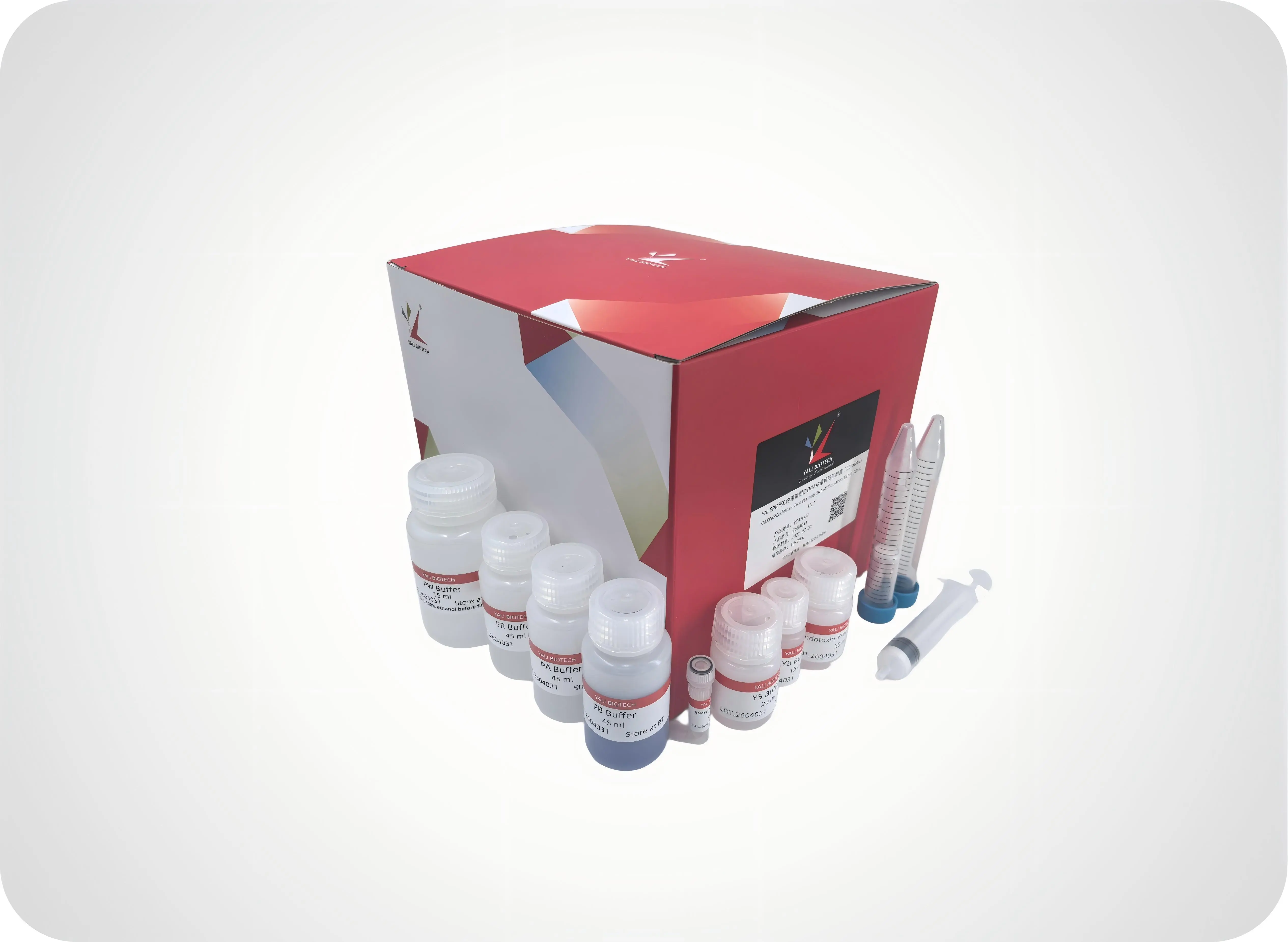
YALEPIC® Endotoxin Free Plasmid Midi DNA Isolation Kit(30-50ml) is intended for extraction from 30 ~ 50 ml of overnight bacterial cultures. It adopts anoptimized alkaline lysis method and features a unique silica membrane adsorption technology and special Buffer ER and Buffer YB for specific binding of plasmids and effective removal of endotoxins, proteins, and other impurities. The whole extraction process takes only 40 min. The extracted plasmid DNA contains minimal endotoxin residue (≤1 EU/μg) and can be used for the transfection of various types of cells and common experiments such as enzyme digestion, PCR, sequencing, and ligation.
30 ~ 50 ml of overnight bacterial culture.
For low-copy-number plasmids, it is recommended to increase the culture volume to ≤100 ml and proportionally increase the amounts of PA, PB, and PM2 Buffer reagents.
Store at 10 ~ 30°C for one year and transport at room temperature.
If ambient temperatures often exceed 30°C, we suggest storing RNase A at 2 ~ 8°C.
After addition of RNase A, Buffer PA is stable for 6 months when stored at 2 ~ 8°C.
This kit is recommended for 30-50 mL of overnight bacterial culture (E. coli, such as DH5alpha, TOP10, etc.). For low-copy plasmids, it is recommended to appropriately increase the culture volume to boost yield. For high-copy plasmids, the culture volume can be appropriately reduced to ensure extraction efficiency.
Through a dedicated endotoxin removal filter and optimized buffer system, this kit controls endotoxin carryover to <=1 EU/microgram of plasmid DNA. This level meets transfection-grade standards, and the extraction product can be directly used for transient and stable transfection of mammalian cells (e.g., HEK293, CHO) and primary cells. If even lower endotoxin levels are required (e.g., <0.1 EU/microgram), options YC47015 (100-300 mL) and YC47018 (100-500 mL) plasmid extraction kits are available.
During the cell lysis and neutralization steps, the indicator undergoes a color change from deep blue to light purple to colorless in response to pH changes, helping operators intuitively judge whether lysis is sufficient and neutralization is complete. This is especially useful for less experienced experimenters, effectively reducing the risk of DNA loss or RNA/protein carryover due to incomplete neutralization or over-lysis.
The high-purity, endotoxin-free plasmid DNA extracted with this kit has been validated by multiple laboratories and is suitable for the following applications: transient and stable transfection of mammalian cells and sensitive cell lines; restriction enzyme digestion and ligation/transformation; Sanger sequencing and high-throughput NGS library construction; PCR, qPCR, RT-PCR, and multiplex PCR amplification; in vitro transcription and RNA synthesis; plasmid transformation and genetic modification of prokaryotic cells.
This kit is stored sealed at 10-30 degrees C room temperature, protected from light, with a shelf life of 18 months. It supports ambient-temperature shipping (recommended environmental temperature controlled at 4-35 degrees C) without cold chain, greatly reducing warehousing and logistics costs. Please calculate the shelf life based on the labeled production date; do not use beyond the expiration date to ensure extraction performance.
Plasmid yield is affected by multiple factors. Common causes include: Plasmid copy number – low-copy plasmids (e.g., pBR322-derived vectors) naturally yield less than high-copy plasmids (e.g., pUC series). Culture condition – insufficient culture time (OD600 <1.0) or excessive culture (OD600 >6.0) both affect yield. Incomplete lysis – insufficient lysis time or inadequate lysis buffer volume prevents complete plasmid release. Excessive washing – missing ethanol addition in wash steps as instructed or excessive wash cycles may cause plasmid to be washed off the membrane. Elution temperature – preheat elution buffer to 65 degrees C before use; low-temperature elution reduces yield. Check the above aspects and follow the manual for standardized operation.
This kit is designed based on the alkaline lysis method and is specifically for plasmid extraction from Gram-negative bacteria (mainly E. coli). For Gram-positive bacteria (e.g., Bacillus subtilis, Staphylococcus aureus), due to differences in cell wall structure, lysis conditions require additional adjustments (e.g., lysozyme addition). This kit has not been specifically optimized for such scenarios and is not recommended for direct use.
RNase A has been pre-mixed into the lysis buffer of this kit, effectively degrading RNA in the bacterial culture during the lysis step. When the product is analyzed by agarose gel electrophoresis, no obvious RNA smear band is typically observed. If the lab is extremely sensitive to RNA carryover, additional RNase A (self-prepared) can be added after the resuspension step for enhanced treatment.
YALI BIOTECH provides a complete product line: mini-prep (1-5 mL culture), midi-prep (5-15 mL culture), (30-50 mL culture), and maxi-prep (100-300 mL culture), (100-500 mL culture) to meet different experimental scale needs. The main differences between this midi-prep kit and the mini-prep kit include: Processing scale – midi-prep supports larger sample volumes (30-50 mL vs. 1-5 mL). Yield – midi-prep yield can reach up to 300 microgram, while mini-prep is typically <45 microgram. Choose the appropriate specification based on experimental scale and downstream application needs.




Production center: 4th floor, Building 9, Yangshan Science and Technology
Industrial Park,No. 8 Jinyan Road, Suzhou High-tech Zone
Marketing center: Pujiang High-tech Park, Minhang District, Shanghai
Copyright: 2026 YALI Biotech Co., Ltd.
 Scan to follow us