

An optimized spin column workflow that turns animal cells and tissues into high-quality total RNA ready for downstream applications.
| Number | Specifications | Catalog Price | Add To Cart |
|---|---|---|---|
| YR23017 | 50T | Online Consult | + |
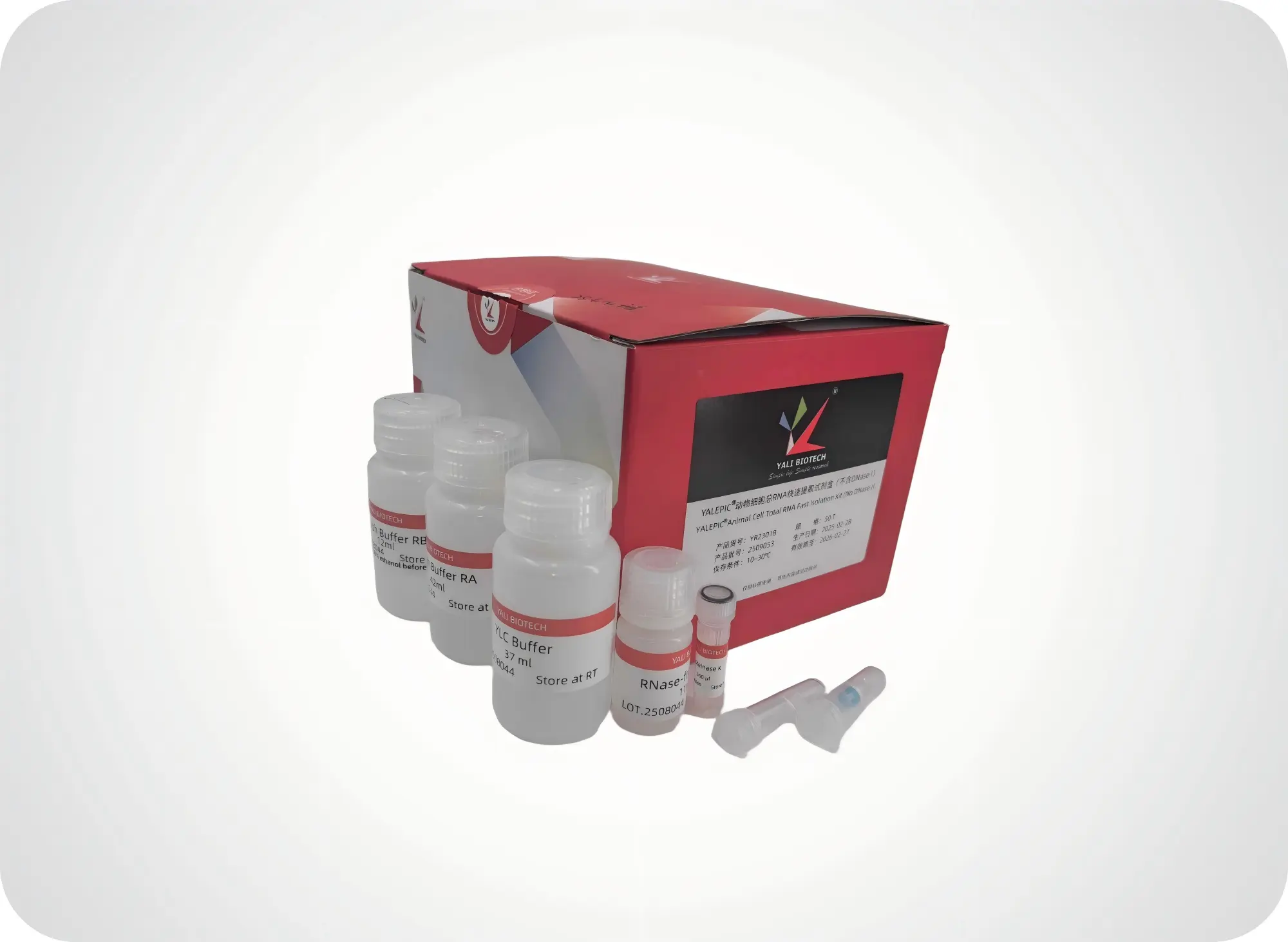
YALEPIC® Animal Cell & Tissue Total RNA Fast Isolation Kit(No DNase I)provides a rapid method for extracting total RNA from animal tissues and cells. The kit is based on silica gel membrane purification technology and does not require β-mercaptoethanol, phenol/chloroform, or any other toxic reagent during the extraction process. It takes only 7 min to extract high-quality RNA. The kit contains Fast gDNA Filter Columns which can effectively remove impurities and gDNA. FastPure RNA Columns RT can efficiently bind RNA with an optimized buffer to obtain high-purity total RNA. The isolated RNA has little gDNA residues and no proteins or other impurities contamination. It can be used for RT-PCR, Real-Time PCR, Microarrarys and other downstream experiments.
Tissue samples:10~30mg;
Cell:≤1×10⁷
Transport at room temperature.
Store at 10 ~ 30°C for one year.
This is a standard 50T kit (catalog YR23017), providing 50 RNA extraction reactions. It is a universal tissue/cell RNA extraction kit suitable for both animal tissues (liver, spleen, kidney, brain, etc.; recommended 10-30 mg) and cultured cells (adherent/suspension; recommended up to 1×10^7 cells), eliminating the need for separate kits.
Suitable for various common animal soft tissues including liver, spleen, kidney, brain, heart, skeletal muscle, and lung. Note: DNA-rich tissues (liver, spleen, kidney) should use no more than 10-20 mg to avoid affecting extraction and increasing gDNA residue risk.
The entire rapid RNA extraction process can be completed in 7 minutes at room temperature – from sample lysis to RNA elution, with no pre-cooled centrifuge or ice-bucket operation needed. All centrifugation is performed at room temperature (15-30 degrees C) using a standard benchtop centrifuge (>=12,000 rpm). This 7-minute room-temperature extraction is a core advantage, compared to traditional TRIzol (~1.5 hours) and conventional column methods (~30 minutes).
Completely unnecessary. This product uses silica membrane column purification technology, with no chloroform, phenol, or beta-mercaptoethanol needed. This is very friendly for laboratory safety management and operator health, especially suitable for labs sensitive to organic reagents or with limited ventilation.
Yes. The kit uses a dual-column filtration system – Fast gDNA Filter Columns effectively remove genomic DNA, combined with optimized wash buffers to remove protein and salt residues. Total RNA purity A260/A280 is typically 1.9-2.1, directly usable for RT-PCR, qPCR, Northern Blot, and other high-purity-requirement downstream experiments. For complete DNA removal (especially for low-abundance gene expression analysis), use RNase-free DNase I for on-column or post-elution digestion.
Yes. The kit includes Fast gDNA Filter Columns for one-step efficient gDNA removal during extraction, with no additional steps needed. For DNA-rich samples (liver, spleen, kidney), keep starting amount to 10-20 mg. For highly DNA-sensitive downstream experiments (qPCR), use RNase-free DNase I for further digestion after RNA elution. Detailed instructions are in the protocol.
All components can be stored dry at 10-30 degrees C room temperature, no refrigeration or freezing needed. Transport at room temperature without cold chain support. This provides great convenience for laboratory inventory management and reduces transport/storage costs. After opening, store at room temperature until the kit expiry date (see bottle label), but avoid repeated opening that may introduce contamination.
All components are designed for stability throughout the shelf life (typically 12-24 months, see bottle label). Tighten caps after each use and store in a clean, dry room temperature environment. Avoid prolonged exposure of lysis and wash buffers to air to prevent solvent evaporation or RNase contamination. No freeze-thaw needed (all components stored at room temperature).
Column clogging is typically caused by: (1) Excessive sample input – refer to recommended amounts (tissue 10-30 mg, cells up to 1×10^7); (2) Insufficient grinding/lysis – grind thoroughly, increase lysis buffer volume and extend lysis time if needed. Do not aspirate precipitate when transferring supernatant to the column. See the troubleshooting section in the protocol for a complete guide.
Low RNA yield may be caused by: insufficient sample (increase amount, but tissue <30 mg, cells <1x10^7); sample degradation from improper storage (use fresh or liquid nitrogen flash-frozen samples at -85 to -65 degrees C, avoid freeze-thaw); insufficient grinding/homogenization (increase lysis buffer volume and time); insufficient elution (add RNase-free ddH2O to membrane center, reduce elution volume, pre-warm to 56 degrees C or extend room temperature incubation, or perform double elution).
The high-purity, high-integrity total RNA is suitable for RT-PCR, real-time quantitative PCR (qPCR/Real-Time RT-PCR), microarray analysis, Northern Blot, Dot Blot, Poly(A) RNA selection, in vitro translation, RNase protection assay, molecular cloning, and more. Products can be used directly or stored long-term at -85 to -65 degrees C.




Production center: 4th floor, Building 9, Yangshan Science and Technology
Industrial Park,No. 8 Jinyan Road, Suzhou High-tech Zone
Marketing center: Pujiang High-tech Park, Minhang District, Shanghai
Copyright: 2026 YALI Biotech Co., Ltd.
 Scan to follow us