
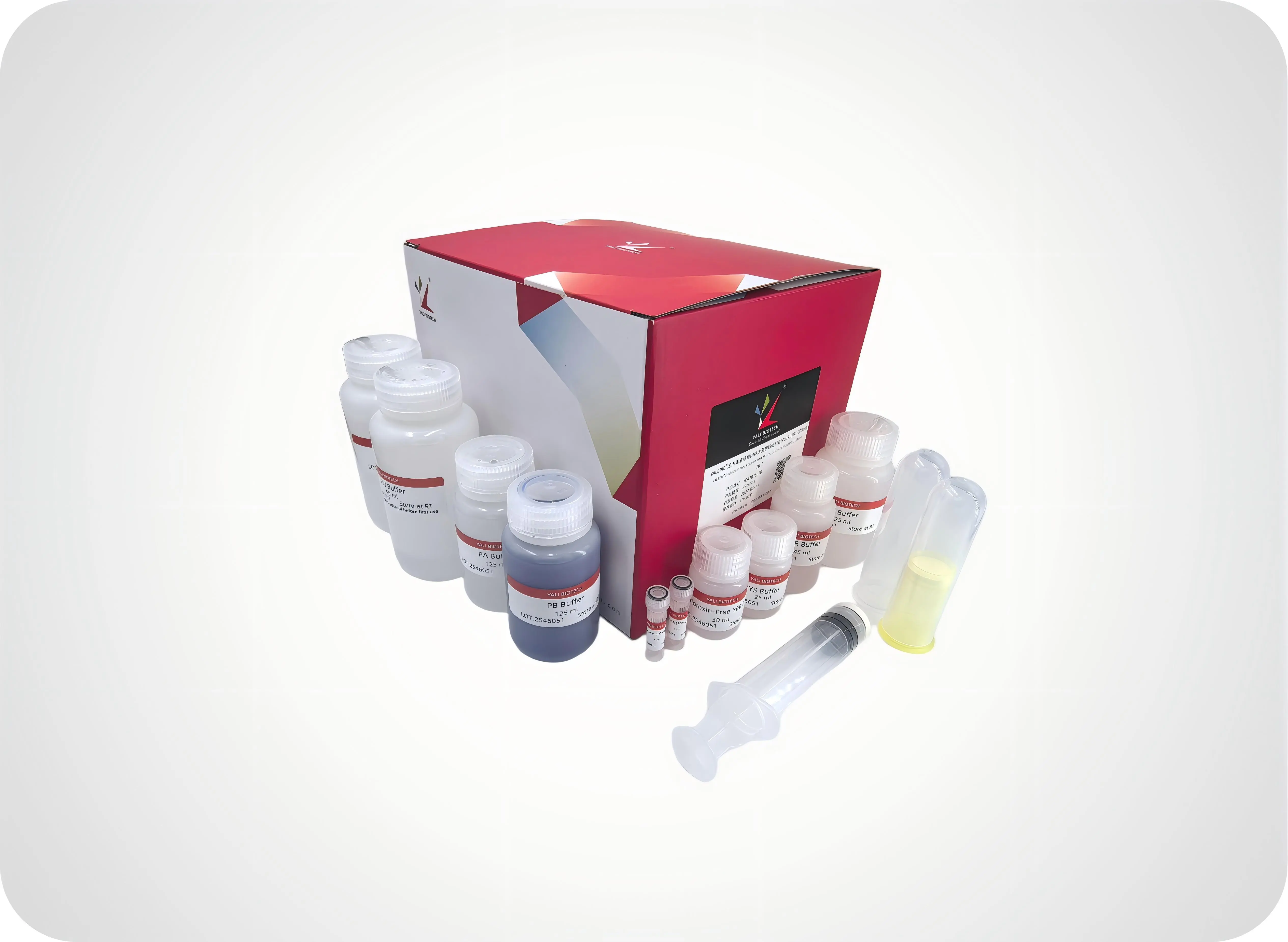
An optimized spin column workflow that turns plasmid from large-volume culture (Plus) into high-quality plasmid DNA ready for downstream applications.
| Number | Specifications | Catalog Price | Add To Cart |
|---|---|---|---|
| YC47015-10 | 10T | Online Consult | + |
YALEPIC® Endotoxin Free Plasmid DNA Maxi Isolation Kit (PLUS) (100-300ml) is suitable for extraction from 100 – 300 ml of bacterial solution cultured overnight, using an improved SDS-alkaline lysis method to lyse the bacteria. The PB solution contains indicators that can indicate whether the lysis and neutralization are complete through the change of color, so as to ensure the quality of plasmid extraction and visualize the operation. A newly developed endotoxin removal solution YEB and separated by centrifugation to remove endotoxins reducing endotoxin levels to as low as 0.1 EU/μg. The purified DNA is suitable for a variety of molecular biology applications including restriction enzyme digestion, ligation, transformation, DNA sequencing, and transfection.
100~300ml of overnight bacterial culture.
Store at 10 ~ 30°C for one year and transport at room temperature.
If ambient temperatures often exceed 30°C, we suggest storing RNase A at 2 ~ 8°C.
After addition of RNase A, Buffer PA is stable for 6 months when stored at 2 ~ 8°C.
Common causes of low plasmid yield and solutions include: (1) Low plasmid copy number – different vectors have significantly different copy numbers. For low-copy plasmids (e.g., pET series, pBR322, pACYC), increase culture volume and proportionally increase lysis buffer volumes. Preheat elution buffer to 65 degrees C to improve elution efficiency. (2) Insufficient bacterial biomass – ensure sufficient volume of overnight culture and ensure cells are in logarithmic growth phase (OD600 approximately 1.0-1.5). Culture time is recommended at 12-16 hours and should not exceed 16 hours. (3) Improper strain storage – long-term glycerol stock storage may lead to plasmid loss. It is recommended to streak or plate to activate the strain before extraction to stabilize yield. (4) Incomplete lysis – after adding resuspension buffer, vortex until the bacterial pellet is fully suspended with no visible clumps. After lysis, gently invert to mix, ensuring complete lysis while avoiding genomic DNA shearing. (5) Improper elution conditions – preheating elution buffer to 65-70 degrees C significantly improves elution efficiency. After adding elution buffer, let it stand for 2-5 minutes to allow full membrane interaction. A second elution can be performed to improve total recovery. (6) Concentration measurement error – when measuring concentration with NanoDrop or similar instruments, use elution buffer (not water) as the blank for zeroing.
Common causes of high endotoxin levels and solutions: (1) Excessive culture volume – too much biomass leads to incomplete lysis, insufficient endotoxin release, and reduced removal efficiency. Strictly follow the kit’s recommended culture volume. (2) Endotoxin removal solution not fully mixed – after adding endotoxin removal solution, thoroughly mix by inverting up and down (>=15 times recommended) to ensure efficient endotoxin binding and removal. (3) Improper operation – when aspirating the supernatant, avoid drawing up the lower layer containing endotoxin-binding complexes. Centrifugation temperature should not be below 23 degrees C, as low temperatures lead to incomplete phase separation.
Genomic DNA contamination is mainly caused by improper lysis step operation: (1) After adding lysis buffer, mix gently by inverting (do not vigorously shake or vortex) to avoid mechanical shearing that fragments genomic DNA into small pieces that co-purify with plasmid. (2) Lysis time should be strictly controlled within 5 minutes. When processing multiple samples, monitor the total time to avoid over-lysis. (3) The neutralization step should be mixed thoroughly but gently to ensure genomic DNA precipitates together with proteins and cell debris and is removed.
(1) Confirm that RNase A has been added to Buffer PA and thoroughly mixed. Buffer P1 with RNase A added should be stored at 2-8 degrees C; prolonged room temperature storage leads to enzyme activity decline. (2) If the culture volume is too large, total RNA in the bacterial pellet may exceed the digestion capacity of RNase A. Appropriately reduce the culture volume. (3) Ensure RNase A is within its shelf life and stored under proper conditions.
Buffers such as Buffer PB containing SDS are prone to crystallization or precipitation under low-temperature conditions. Heat in a 37 degrees C water bath until completely dissolved, mix well, and use normally; this does not affect extraction performance.
(1) Increase bacterial biomass and proportionally increase the volume of each lysis buffer component to ensure complete cell lysis. (2) Preheat elution buffer to 65-70 degrees C to improve elution efficiency of large plasmids from the silica membrane. (3) Appropriately extend incubation times for binding and elution steps (e.g., extend binding to 5 minutes and elution to 5-10 minutes) to increase extraction efficiency.
For short-term storage (1-2 weeks), store at 2-8 degrees C. For long-term storage, store at -20 degrees C or -70 degrees C, avoiding repeated freeze-thaw. Plasmid DNA should be dissolved in low-salt buffer (such as the kit’s Elution Buffer).
Yes. The plasmid extracted with this kit has extremely low endotoxin carryover (<0.1 EU/microgram), high purity, and stable quality, suitable for advanced transfection experiments in most cell lines (including endotoxin-sensitive cell lines and primary cells) without additional purification steps.
Not recommended. Using rich media such as TB for bacterial culture may elevate endotoxin levels beyond the removal capacity of the kit. Standard LB medium is recommended to ensure endotoxin carryover meets specifications.
EndA- (endonuclease I deficient) E. coli strains such as DH5alpha, TOP10, and XL10-Blue are recommended. These strains prevent plasmid DNA degradation by endonuclease I, yielding higher quality and quantity plasmid.
(1) After using Buffer PB, cap the bottle immediately to prevent CO2 in the air from reacting with NaOH, reducing lysis efficiency. (2) After adding Buffer PB, mix gently by inverting (do not vortex); lysis time should not exceed 5 minutes. (3) After adding ER (neutralization solution), mix gently by inverting immediately until a white flocculent precipitate appears, ensuring complete neutralization. (4) With the blue indicator present: when lysis is complete, the solution is uniformly blue; when neutralization is complete, the blue color disappears and a white precipitate forms – this color change is a key indicator for judging whether the operation has been performed correctly.
This kit offers the following differentiated advantages: (1) Lower endotoxin carryover: <0.1 EU/microgram, at the industry-leading level (most mainstream competitors are <0.1-1 EU/microgram), meeting higher transfection standards. (2) Faster extraction: complete workflow approximately 50 minutes, no ice bath required, more efficient than the 60-90 minutes of most competitors. (3) Visual blue indicator: helps users intuitively judge whether lysis and neutralization are complete, reducing experience-based judgment errors and ensuring batch-to-batch consistency. (4) High yield: 100-300 mL culture system can yield up to 2-3 mg plasmid DNA, superior to most competitors of the same specification. (5) No phenol/chloroform extraction: safer and more environmentally friendly operation, no ethanol precipitation required, simpler workflow.


Production center: 4th floor, Building 9, Yangshan Science and Technology
Industrial Park,No. 8 Jinyan Road, Suzhou High-tech Zone
Marketing center: Pujiang High-tech Park, Minhang District, Shanghai
Copyright: 2026 YALI Biotech Co., Ltd.
 Scan to follow us